

Raw prospect data sits in your CRM like uncut diamonds: valuable but unusable until properly refined. AI‑powered data enrichment transforms those scattered contact records into precision‑targeted buyer intelligence that drives measurable revenue outcomes. The integration of AI across revenue functions is projected to contribute over $4.4 trillion in global economic value annually.
The challenge facing GTM teams today goes beyond data volume. Legacy enrichment tactics create fragmented workflows where sales reps spend hours on manual research, marketing teams guess at segmentation, and revenue leaders lack confidence in pipeline forecasts. Meanwhile, modern competitors run enrichment on autopilot AI-driven systems that validate, enhance, and act on data in real time across CRMs and connected apps, a capability that sits at the core of revenue orchestration for modern GTM teams.
AI‑powered enrichment layers machine learning, external data sources, and predictive analytics onto your existing data. The result is actionable buyer intelligence that accelerates deal velocity, improves conversion rates, and scales personalization across the sales lifecycle.
This guide examines the leading AI data enrichment tools, explains evaluation criteria for GTM success, and shares real‑world use cases that demonstrate measurable ROI. It also shows how autonomous AI workers like Alice from 11x turn enrichment from a manual process into a 24/7 revenue engine.
What Is AI Data Enrichment (and How It Works)
AI data enrichment applies artificial intelligence algorithms to enhance existing CRM data with external sources, behavioral signals, and sentiment analysis. Unlike static database updates, AI systems continuously learn from engagement outcomes to improve data accuracy and data quality.
Input stage: Raw CRM data, contact details, company names, job titles, phone numbers, and firmographics forms the base layer. Most records contain gaps, duplicates, or outdated fields that limit GTM accuracy.
Enrichment stage: Algorithms cross‑reference each record against multiple external sources like LinkedIn, company websites, and social media activity. They identify missing data points, validate contact data, and append contextual attributes such as tech stack, funding events, or recent job changes.
Output stage: Enhanced profiles emerge with verified customer data, enriched firmographics, and behavioral insights. This produces segmentation‑ready datasets that power personalized campaigns and intelligent follow‑ups.
Modern enrichment relies on continuous automation through APIs, strong data management, and connected workflows. Compliance safeguards ensure GDPR and CCPA alignment with transparent sourcing, audit logs, and consent management across systems.
Advanced AI systems like 11x go further with autonomous execution. Alice tracks social media and intent signals, enriches profiles in real time, and triggers targeted outreach the moment high‑value buying intent appears without human intervention.
Why Data Enrichment Matters for GTM and Revenue Teams
High‑quality enrichment compounds perform across your revenue organization.
Sharper ICP and segmentation: Enriched data clarifies who your best buyers are industry, size, technology use, and even buying committees, helping you prioritize high‑value accounts and boost data quality.
Personalization and lead scoring: Complete profiles unlock hyper‑relevant messaging and accurate scoring criteria, aligning directly with AI‑driven lead qualification that prioritizes buyers based on verified intent data.
Sales velocity and forecasting accuracy: When each record reflects real‑time buyer intent/funding rounds, new leadership, or technology adoption teams can act faster and connect their sales motion to measurable outcomes.
Evaluation Criteria: How We Compared AI Data Enrichment Platforms
Our evaluation focuses on how effectively each platform transforms customer data into operational intelligence. Because data enrichment can range from basic record cleanup to autonomous buyer signal detection, we focused on functionality that drives measurable commercial outcomes.
We assessed each tool through five key lenses aligned to GTM workflows:
- Data coverage and variety: the mix of firmographic, technographic, and behavioral signals integrated from multiple data sources, including social media and intent feeds.
- Accuracy and match rate: the level of validation applied to maintain CRM cleanliness and data quality.
- AI intelligence: the extent to which machine learning enables continuous inference and adaptive scoring.
- Integration efficiency: strength of native API connections with CRMs like Salesforce, HubSpot, and Pipedrive, as well as other GTM apps.
- Automation and governance: depth of automation (manual, rule‑based, or fully autonomous) plus compliance posture under GDPR and CCPA. Compliance frameworks like those defined by ISO/IEC 27001 outline best practices for data protection and integrity across cloud environments.
This methodology prioritizes measurable results and how each tool improves data management, accuracy, and continuous enrichment. The comparison reflects AI‑driven scalability, privacy readiness, and the ability to convert clean data into pipeline velocity.
Comparison Summary Table
11x (Alice + Julian) – Autonomous AI Data Enrichment and Execution

11x transforms traditional data enrichment into autonomous, full‑funnel revenue execution. Its digital workers—Alice, the AI SDR, and Julian, the AI inbound assistant—layer intelligence, enrichment, and engagement into one living system. Alice continuously enriches CRM records by detecting buying signals across LinkedIn, email, and web activity, updating lead profiles in real time. Rather than simply appending data, 11x’s agents act on it, triggering outreach as soon as buying intent emerges. This creates a closed‑loop feedback system where every engagement teaches the model to refine ICP definitions, scoring logic, and outreach patterns automatically. SOC 2 Type II and GDPR‑aligned, 11x operates as a secure, enterprise‑ready enrichment engine that converts static CRM content into continuously learning revenue intelligence.
Data and Features:
- Multi‑source enrichment from intent data, CRM inputs, web activity, and external firmographic sources.
- Real‑time profile enrichment, deduplication, validation, and engagement triggers.
- Deep integrations with Salesforce, HubSpot, and native CRMs for bidirectional data sync.
- Predictive analytics and autonomous lead scoring for prioritization accuracy.
- Continuous learning loop from historical engagement to adapt ICP targeting and personalization.
Pros: Fully autonomous enrichment and execution; predictive learning; enterprise compliance; measurable output through booked pipeline.
Cons: Custom enterprise setup; tailored onboarding required to fit proprietary sales systems.
Best Fit and Comparison: Ideal for scale‑oriented revenue teams seeking complete GTM autonomy. Unlike traditional enrichment platforms (ZoomInfo, Clearbit, or Cognism), 11x doesn’t stop at data accuracy—it executes, learns, and optimizes outreach automatically.
Clay – AI‑Driven Enrichment Orchestration
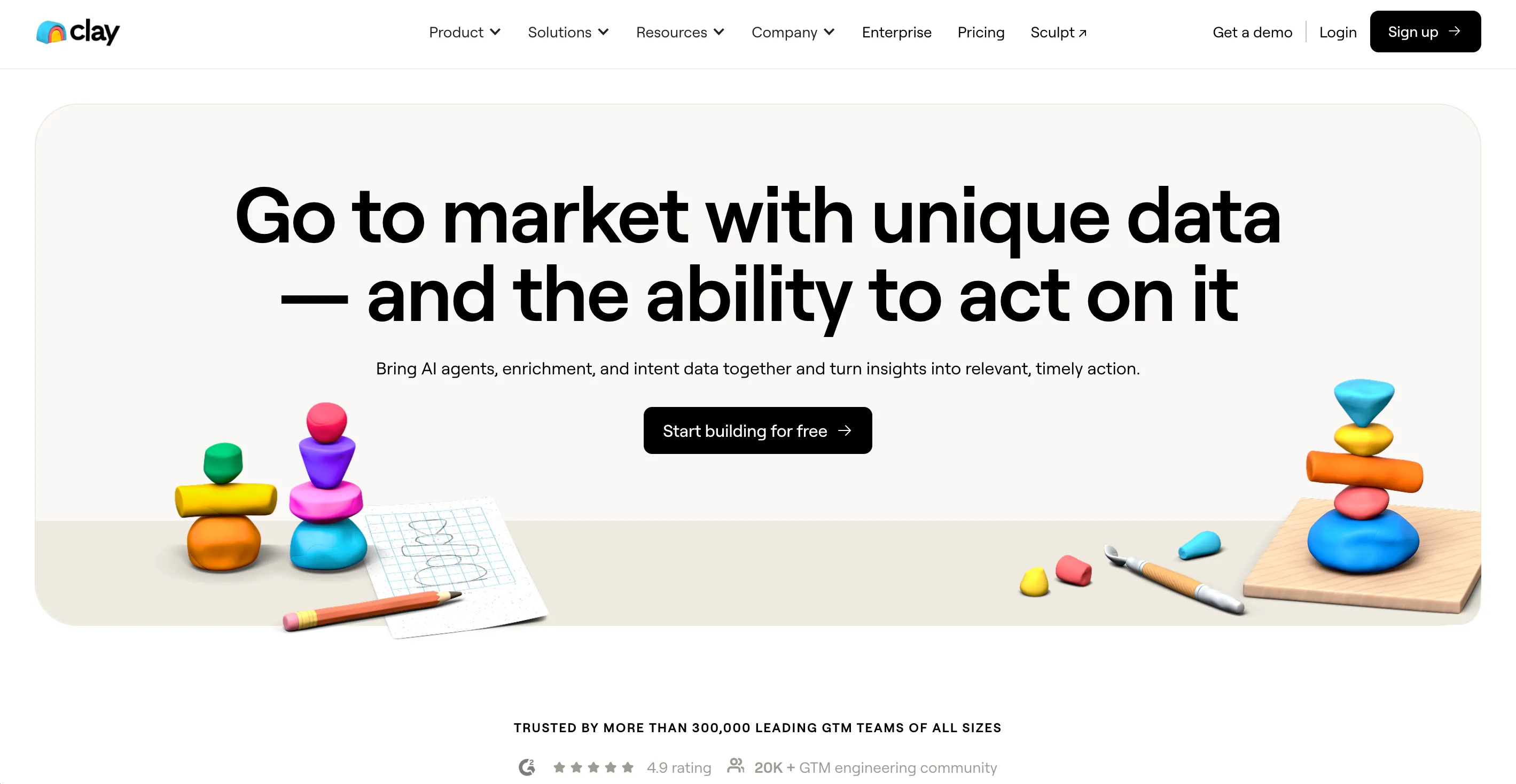
Clay sits at the intersection of enrichment, automation, and experimentation. It enables data‑driven GTM teams to aggregate, cleanse, and personalize leads using APIs and AI logic. Clay enriches CRM data with firmographic and behavioral signals, pulling from LinkedIn, Clearbit, Crunchbase, and other external sources. Teams define ideal customer profiles (ICPs) and Clay automatically updates contact fields as new data appears—funding changes, leadership shifts, or product launches. The result is continuously refreshed intelligence ready to fuel outbound campaigns. Clay’s strength lies in its flexibility: it’s programmable, modular, and perfect for technical teams building dynamic enrichment workflows tailored to their motion.
Data and Features:
- Aggregates APIs from 50+ providers for cross‑verified enrichment.
- Combines firmographic, technographic, and intent signals into live updates.
- AI‑enhanced field generation (job summaries, industry relevance, fit scoring).
- Integrates via Zapier, HubSpot, Salesforce, Notion, and Airtable.
- Supports custom data pipelines that update records automatically as markets shift.
Pros: Deep customization; wide integration ecosystem; continuous verification and field enrichment.
Cons: Technically demanding; requires manual configuration and maintenance; not autonomous by default.
Best Fit and Comparison: Best for RevOps and data engineers building enrichment layers internally. While Clay specializes in flexible enrichment design, 11x operationalizes it, autonomously researching, enriching, and acting on signals to convert enriched data instantly.
Relevance AI – Unstructured Data Enrichment and Intelligence Mapping
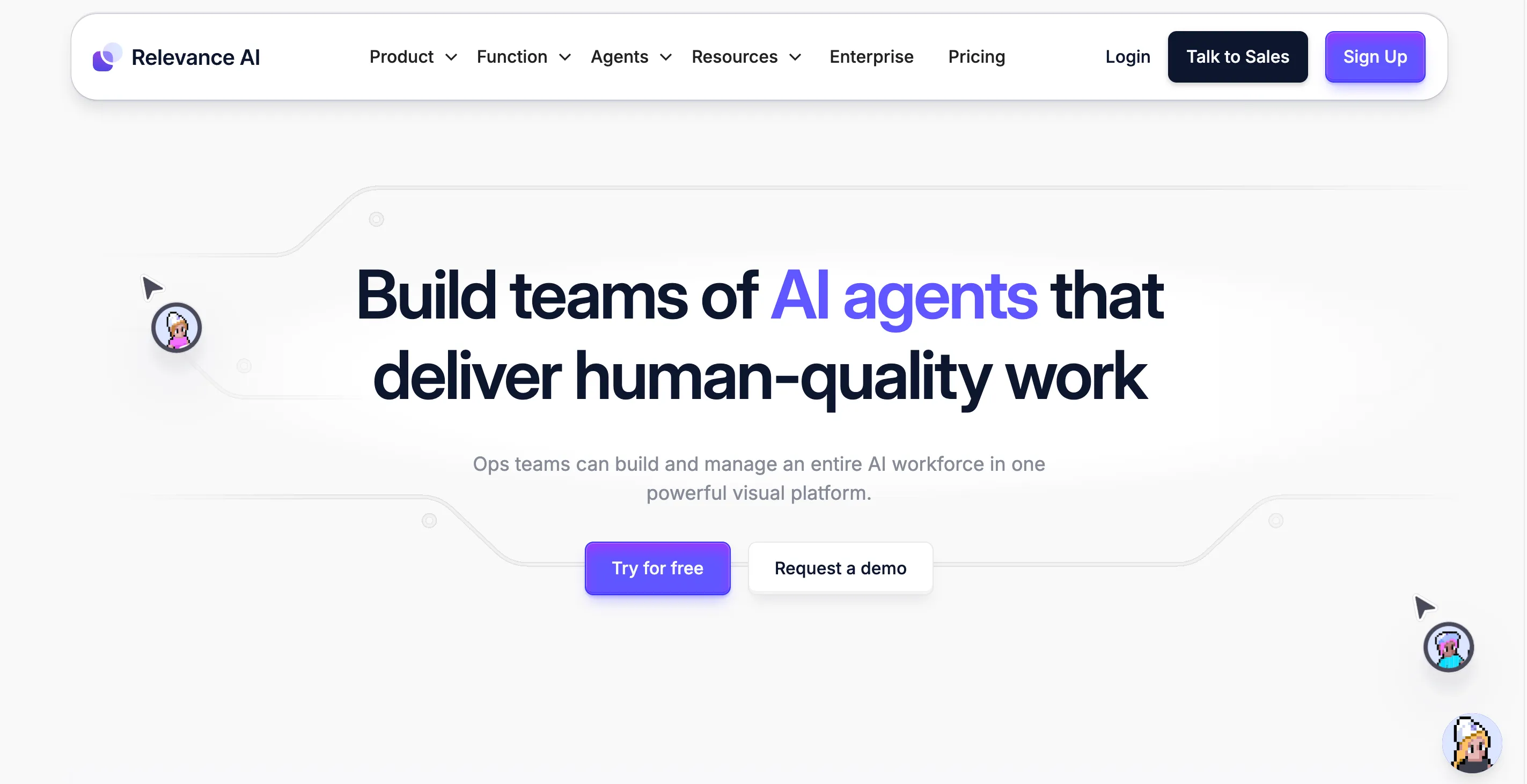
Relevance AI specializes in transforming unstructured data—emails, notes, call transcripts, survey text- into structured vector embeddings for enrichment and analysis. Its AI models extract sentiment, topics, and buying intent cues that CRMs typically miss. This empowers GTM and customer‑facing teams to turn qualitative data into predictive sales signals. Relevance AI’s vector search capabilities cluster prospects and accounts by behavioral similarity, enabling adaptive enrichment and segmentation beyond firmographics. It bridges data science and revenue operations by embedding ML pipelines into enrichment workflows that continuously retrain on outcomes, improving lead qualification and prioritization accuracy over time.
Data and Features:
- Converts unstructured CRM or inbox text data into structured embeddings.
- Vector search and clustering to identify buyer behavior and sentiment trends.
- API‑first design linking directly with CRM, analytics, and BI systems.
- ML‑based enrichment models retrain automatically as new outcomes are logged.
- Bulk processing for text, call transcripts, and notes across datasets.
Pros: Captures context and signals missed by static databases; adaptive, self‑learning AI that scales enrichment precision.
Cons: Requires technical setup; focuses on analysis rather than outreach or operational automation.
Best Fit and Comparison: Ideal for AI‑mature teams enriching large unstructured datasets. Compared to 11x, which translates enriched signals into real‑time outreach, Relevance AI’s strength lies in deep semantic intelligence extraction—11x then acts on such enriched insights autonomously.
ZoomInfo – Commercial‑Grade B2B Data Enrichment
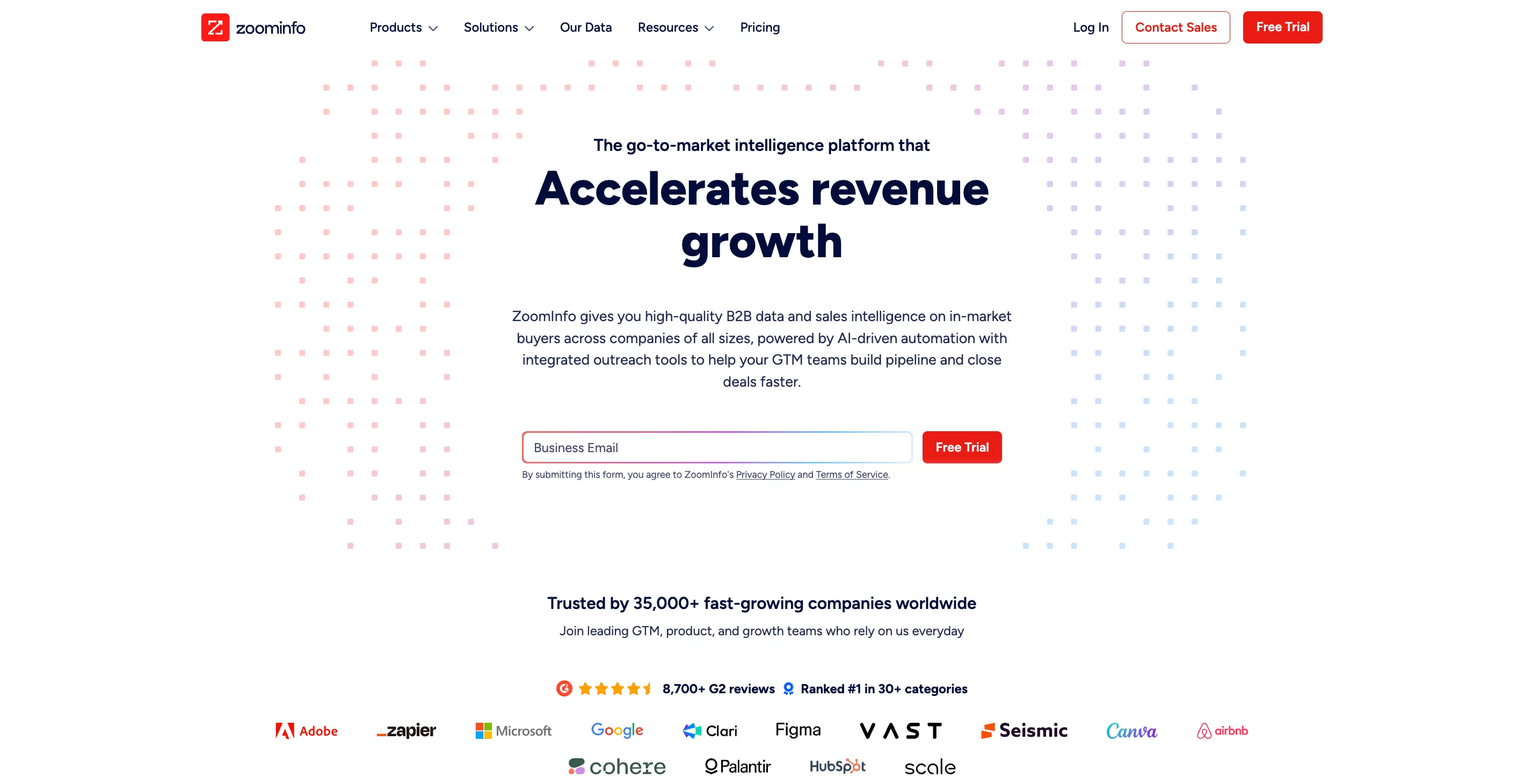
ZoomInfo offers one of the largest verified B2B contact and company datasets, combining human verification with automation to maintain accuracy at scale. For GTM teams, it functions as a powerful enrichment base layer, cleaning CRM data, adding firmographics, and validating contact details. Enriched records enable sharper ICP segmentation and more accurate targeting. ZoomInfo also includes intent data and web activity signals that identify high‑propensity accounts. While automation supports bulk updates through native connectors, its operation remains largely manual, with users deciding how to act on enriched records. The platform emphasizes breadth, data cleanliness, and reliability rather than autonomous operation.
Data and Features:
- Comprehensive B2B database with firmographic and contact enrichment.
- Intent and technographic tracking integrated through Scoops and Intent Signals.
- Direct integrations with Salesforce, HubSpot, Marketo, and Outreach.
- APIs for bulk enrichment and ongoing CRM hygiene.
- Automated field updates via workflow triggers in native CRM connectors.
Pros: High accuracy and global coverage; deep CRM integration; proven reliability; strong intent layer.
Cons: Workflow still manual; lacks native self‑learning or autonomous enrichment; premium enterprise pricing.
Best Fit and Comparison: Best for large B2B organizations focused on accurate enrichment and segmentation. 11x builds on ZoomInfo‑like coverage but eliminates manual intervention, learning from response patterns to trigger targeted, AI‑driven outreach instantly.
Clearbit – Real‑Time B2B Identity Enrichment

Clearbit’s API‑first design powers real‑time data enrichment for CRMs, web forms, and marketing automation platforms. When a new record enters the system, Clearbit instantly fills missing attributes such as company size, industry, and location, ensuring up‑to‑date firmographic coverage across the funnel. Its standout feature is speed—enrichment happens in milliseconds, allowing real‑time personalization during inbound interactions. Businesses use Clearbit to qualify visitors, score leads, and route them efficiently, reducing sales response latency. However, while it enhances lead data dynamically, it doesn’t autonomously act on signals; its role is precision enrichment, not autonomous execution.
Data and Features:
- Real‑time enrichment API with 200+ firmographic fields.
- Domain‑to‑person and person‑to‑company matching for identity verification.
- Integrations with Salesforce, HubSpot, Marketo, and Segment.
- Lead scoring and routing automation via Clearbit Reveal and Enrichment APIs.
- Privacy‑compliant data sourcing and transparent field-level accuracy scoring.
Pros: Instant enrichment capabilities; best for high‑velocity inbound flows; strong API documentation and speed.
Cons: Limited deep personalization; not AI‑autonomous; enrichment stops at data enhancement, not engagement.
Best Fit and Comparison: Ideal for marketing and inbound teams optimizing form fill accuracy and lead routing. Clearbit fuels data precision, while 11x builds on that data—in real time—executing personalized outreach sequences as soon as enrichment completes.
Apollo.io – Enrichment‑Driven Prospect Discovery

Apollo.io combines an extensive prospect database with built‑in enrichment, allowing GTM teams to discover and validate leads efficiently. AI models cross‑verify contact records, ensuring accuracy before syncing to CRM. The platform enhances entries with verified phone numbers, technographics, hiring data, and intent signals pulled from millions of business records. It also integrates light automation features: email sequencing, list generation, and engagement analytics, making it a bridge between enrichment and execution. For teams building early data infrastructures, Apollo.io provides affordable enrichment quality and reach, though it doesn’t operate autonomously after enrichment is complete.
Data and Features:
- 275 + million verified global contacts with real‑time verification.
- Built‑in enrichment engine combining contact, technographic, and intent attributes.
- Chrome extension for instant enrichment from LinkedIn or Gmail.
- Seamless CRM integrations with Salesforce, HubSpot, and Outreach.
- Basic sequencing tools and analytics for follow‑up performance tracking.
Pros: Extensive verified database; continuous data validation; cost‑effective entry to enrichment.
Cons: Limited automation depth; enrichment accuracy strong but not predictive; manual activation is needed post‑enrichment.
Best Fit and Comparison: Perfect for small to mid‑size sales teams constructing initial enrichment pipelines. 11x extends beyond Apollo’s static enrichment—converting enriched signals into autonomous outreach, qualification, and follow‑up actions instantly.
Cognism – GDPR‑Compliant Global Data Enrichment

Cognism positions itself as the compliance‑first enrichment platform for international revenue teams. Its dataset is fully GDPR and CCPA aligned, with consent‑verified contact and company information across EMEA, North America, and APAC. Cognism enriches CRM records with firmographic, technographic, and intent‑based signals, while ensuring full data provenance transparency. Its proprietary “Diamond Data” combines AI‑driven validation and human verification to maintain industry‑leading accuracy. While enrichment automation is available, outreach execution depends on external tools. Cognism’s value is in trusted, compliant data quality that supports clean, audit‑ready CRM environments.
Data and Features:
- GDPR/CCPA‑certified enrichment dataset covering global business markets.
- Firmographic, technographic, and intent overlay for segmentation accuracy.
- “Diamond Data” human‑verified enrichment pipeline.
- Direct CRM integrations (Salesforce, HubSpot) for continuous hygiene.
- Compliance reporting and consent traceability within each record.
Pros: Highest compliance assurance; ultra‑clean, verified datasets; strong European coverage; consistent match confidence.
Cons: Limited automation and AI execution; primarily a high‑integrity enrichment feed, not an autonomous engine.
Best Fit and Comparison: Suited for RevOps and compliance‑driven organizations operating under strict privacy frameworks. When paired with 11x, Cognism data becomes dynamic, feeding 11x’s autonomous digital workers who execute on those trusted records instantly and compliantly.
Real‑World Use Cases and Outcomes
Data hygiene and CRM optimization remove duplicates, clean contact data, and enrich missing phone numbers, improving data accuracy and consistency across sales dashboards.
ICP refinement and segmentation reveal firmographic trends and guide high‑value targeting strategies. Tools like 11x automatically adjust segmentation templates using predictive machine learning.
Personalization and follow‑ups at scale replace static outreach lists with dynamic, AI‑driven campaigns. Using AI, Alice analyzes engagement outcomes, optimizing content templates and sending timing for better conversion rates.
Predictive analytics and forecasting improve data management and clarity, helping marketing and sales teams anticipate deal momentum based on verified datasets.
Key Factors to Consider Before Choosing a Tool
- Source transparency and GDPR/CCPA compliance ensure that CRM data enrichment can scale reliably.
- Integration compatibility with CRMs, spreadsheets, and APIs ensures smooth data integration across apps.
- Data quality and data management processes safeguard enrichment accuracy over time.
- Pricing models (per-record, per-API, or outcome-driven) should be evaluated carefully to ensure total value for your dataset volume.
From Raw Data to Real Outcomes
AI‑powered data enrichment turns CRMs and connected apps into self‑optimizing revenue engines. With clean, continuously updated data, enrichment doubles as automation for high‑value outreach and consistent follow‑ups that reflect real‑time accuracy.
11x’s digital workers bring enrichment, engagement, and process improvement into a single autonomous system built for measurable growth. Discover how AI data enrichment can accelerate your revenue workflows and experience Alice in action.
Frequently Asked Questions
AI systems validate existing data across multiple external sources, ensuring high data accuracy and data quality. 11x’s autonomous agents advance further, using AI to refine which signals most predict conversion.
From per‑record APIs to subscription bundles, costs align with enriched volume and functionality. 11x simplifies this by pricing enrichment through outcomes, charging proportionally to the booked pipeline rather than usage.
Yes. Verified information like phone numbers and intent indicators enable intelligent follow‑ups. Alice activates campaigns through enriched customer data to optimize response timing automatically.
Enterprise solutions maintain strict consent management. 11x’s framework includes SOC2 Type II and CASA Tier 3 certification to protect customer data and govern enrichment enhancement securely.
Startups avoid manual list updates by using AI to maintain clean, enriched records. 11x’s digital workers autonomously perform enrichment, qualification, and engagement, delivering enterprise‑level results with minimal data management overhead.
.png)
.png)
.png)
.png)