
Enterprise Sales Prospecting: The Complete 2025 Guide to Filling Your Pipeline with High-Value Accounts
.png)

Enterprise sales prospecting isn't just harder than mid-market or SMB outreach; it's a fundamentally different discipline. When deal sizes reach six or seven figures and sales cycles stretch across quarters, the playbook changes. You're not chasing quick wins. You're orchestrating multi-threaded campaigns across buying committees of 8-12 stakeholders, navigating procurement processes that can stall deals for months, and building relationships that require sustained engagement across LinkedIn, email, phone calls, and in-person meetings.
The challenge? Most sales teams still run enterprise prospecting like it's 2019. Manual research. Static templates. Fragmented follow-ups. CRM data that's outdated before your first call. Meanwhile, enterprise buyers expect personalized, insight-driven conversations from the first touchpoint, and they'll ghost you the moment your outreach feels generic.
This guide breaks down the full enterprise sales prospecting process: how to identify high-value accounts, build multi-channel engagement strategies, leverage automation without losing the human touch, and close deals that move the revenue needle. We'll also compare the leading sales tools built for enterprise prospecting, from data platforms like ZoomInfo to AI-powered digital workers like 11x that autonomously execute outreach at scale.
If you're a RevOps leader, sales professional, or account executive tasked with filling pipeline from large organizations, this is your roadmap.
What Is Enterprise Sales Prospecting?
Enterprise sales prospecting is the systematic process of identifying, researching, and engaging decision-makers at large companies to generate qualified pipeline for high-value deals. Unlike SMB or mid-market prospecting, enterprise prospecting requires navigating complex organizational structures, longer sales cycles (often 6-18 months), and multi-stakeholder buying processes involving procurement, legal, IT, and executive leadership.
The core difference: enterprise deals demand precision over volume. You're not blasting 1,000 cold emails hoping for a 2% reply rate. You're building account-specific strategies that address the unique pain points of each buyer persona, from the VP of Sales who needs ROI forecasting to the CTO evaluating your tech stack integration with Salesforce or HubSpot.
Key characteristics of enterprise prospecting:
- Higher deal sizes: $100K+ ARR contracts that justify months of relationship-building
- Longer sales cycles: Multiple discovery calls, demos, pilot programs, and procurement reviews
- Multi-threading: Engaging 5-10+ stakeholders simultaneously across departments
- Risk mitigation: Enterprise buyers need case studies, references, and proof of enterprise-level security and support
- Strategic alignment: Your solution must map to company-wide initiatives, not just departmental needs
This complexity is why enterprise sales software has evolved beyond basic CRM tools. Modern enterprise prospecting requires data intelligence, workflow automation, and AI-driven personalization working in concert.
The Enterprise Sales Process: Step-by-Step Breakdown
Understanding the full enterprise sales process helps you see where prospecting fits, and where bottlenecks kill deals.
1. ICP Definition and Account Segmentation
Start by defining your Ideal Customer Profile with enterprise-specific firmographics: company size (typically 1,000+ employees), industry verticals, tech stack signals, and buying triggers like funding rounds or leadership changes. Tools like ZoomInfo and LinkedIn Sales Navigator surface these signals in real time.
2. Account Selection and Prioritization
Not all enterprise accounts are equal. Use intent data and engagement scoring to prioritize accounts showing active buying behavior. Focus on companies where you have existing relationships, referrals, or clear alignment with their strategic initiatives.
3. Multi-Threaded Outreach and Engagement
Enterprise deals die when you rely on a single champion. Build relationships across the buying committee: the economic buyer (CFO/VP), technical evaluator (CTO/IT Director), end users (sales reps, account executives), and influencers (customer success leaders). Each persona needs tailored messaging that addresses their specific pain points.
This is where AI SDR tools like Alice from 11x excel, autonomously researching each stakeholder and crafting personalized outreach across LinkedIn, email, and follow-up sequences without manual intervention.
The adoption of generative AI across enterprise sales has become mainstream sales and marketing functions seeing the largest year-over-year increase in gen-AI deployment in the past year, contributing up to $1.2 trillion in potential productivity gains across commercial organizations
4. Qualification and Consultation
Enterprise qualification goes deeper than BANT. You need to understand decision-making processes, budget cycles, competitive evaluations, and internal politics. Discovery calls should uncover not just needs but the organizational dynamics that will accelerate or stall your deal.
5. Proposal, Procurement, and Negotiation
Enterprise buyers expect detailed proposals with ROI models, security documentation, and SLA commitments. Procurement teams will negotiate pricing, terms, and implementation timelines. This stage can stretch for months, which is why maintaining engagement through automated lead generation workflows prevents deals from going dark.
6. Post-Sale Expansion and Upselling
Enterprise prospecting doesn't end at close. Customer success teams should identify upselling opportunities, expansion into new departments, and referrals to other large organizations. The best enterprise sales teams treat existing accounts as their highest-value prospecting channel.
Common pain points across this process:
- Slow follow-ups that let competitors slip in
- Fragmented CRM data that creates blind spots
- Manual handoffs between SDRs, account executives, and customer success
- Inability to maintain consistent engagement across long sales cycles
Modern AI sales automation tools solve these bottlenecks by orchestrating workflows that keep deals moving without constant human oversight.
Enterprise Prospecting Strategy: What Actually Works in 2025
Enterprise prospecting strategy has shifted from spray-and-pray cold calling to precision-targeted, multi-channel campaigns. Here's what separates high-performing enterprise sales teams from the rest.
Define Your ICP with Enterprise-Level Precision
Your ICP for enterprise accounts should go beyond basic firmographics. Layer in technographic data (what CRM, sales tools, and tech stack they use), intent signals (are they actively searching for solutions like yours?), and organizational triggers (new funding, leadership changes, expansion into new markets).
Platforms like ZoomInfo and Cognism provide this intelligence, but the real leverage comes from acting on it fast. When a target account shows buying intent, you need outreach live within hours, not days.
Personalize Outreach at Scale
Enterprise buyers can smell a template from a mile away. Every message needs account-specific research: recent company news, pain points inferred from their industry, and value propositions tied to their strategic goals.
The challenge: doing this manually for 50+ accounts is impossible. This is where AI-powered personalization engines shine. 11x Alice goes further, autonomously researching prospects across LinkedIn and public data, then crafting and sending personalized messages across email and social channels without manual intervention.
Build Relationships Through Multi-Channel Engagement
Enterprise deals require touchpoints across multiple channels: LinkedIn outreach, cold emails, phone calls, webinars, case studies, and in-person meetings. Each channel serves a different purpose:
- LinkedIn: Build credibility and warm up cold prospects
- Email: Deliver detailed value propositions and case studies
- Phone calls: Qualify urgency and navigate stakeholder dynamics
- Webinars and events: Engage multiple stakeholders simultaneously
The key is consistency. Enterprise buyers need 8-12 touchpoints before they engage, and gaps in follow-up kill momentum. AI LinkedIn outreach tools automate this cadence while maintaining personalization.
Leverage Referrals and Customer Success
The fastest path into an enterprise account is a warm introduction. Incentivize your existing enterprise clients to provide referrals. Customer success teams should proactively identify expansion opportunities and cross-sell into new departments.
Deploy AI and Automation for Always-On Execution
Modern GTM teams use AI digital workers to handle the repetitive, high‑volume tasks such as research, outreach, and follow‑ups, all while human reps focus on high‑value conversations and closing deals, supported by advanced sales‑intelligence solutions that surface real‑time buying signals across channels.
11x's Alice operates as an autonomous SDR, identifying high-intent leads, executing multi-channel campaigns, and booking qualified meetings 24/7. Julian, the AI phone agent, handles inbound qualification and follow-up calls, ensuring no lead goes cold.
How to Evaluate Enterprise Prospecting Tools: Our Methodology
Not all sales tools are built for enterprise prospecting. Many platforms excel at SMB outreach but lack the data depth, integration quality, and governance features enterprise teams require. Next‑generation B2B platforms must combine robust data coverage, AI‑driven automation, and compliance‑grade governance to meet enterprise GTM standards.
Our evaluation methodology prioritizes neutral, criteria-driven analysis: 90% objective feature comparisons, 10% strategic insights from GTM experience. Each tool is assessed across seven dimensions:
- Enterprise Readiness: Does it handle complex org structures, multi-stakeholder workflows, and long sales cycles?
- Data Coverage and Accuracy: Quality of contact data, firmographics, technographics, and intent signals
- Integration Depth: Native connections to Salesforce, HubSpot, Outreach, LinkedIn Sales Navigator, and other enterprise tech stacks
- AI Sophistication: Level of automation—from basic sequencing to fully autonomous execution
- CRM Data Enrichment: Real-time data sync and enrichment capabilities
- Governance and Security: SOC 2 compliance, data privacy, and enterprise-grade security
- Measurable ROI: Pricing transparency, time-to-value, and impact on pipeline metrics
These criteria reflect what enterprise sales teams actually need: tools that integrate seamlessly, provide accurate data, and scale without adding headcount.
Comparison Snapshot
Enterprise Prospecting Tools Compared: Features, Pricing, and Best Fit
Here's how the leading platforms stack up for enterprise sales prospecting.
11x

11x isn't a tool, it's a digital workforce. Alice, the AI SDR, autonomously identifies high-value prospects, researches their pain points across LinkedIn and public data, and executes personalized multi-channel campaigns to book qualified meetings. Julian, the AI phone agent, handles inbound qualification and follow-up calls, ensuring speed-to-lead and consistent engagement.
Key Features:
- Autonomous prospecting: Alice operates 24/7, identifying buying signals and engaging decision-makers without manual oversight
- Multi-channel execution: Seamless outreach across email, LinkedIn, and phone
- CRM enrichment: Real-time data sync with Salesforce and HubSpot
- Self-learning AI: Continuously improves messaging and targeting based on engagement data
- Enterprise-grade security: SOC 2 Type II certified, GDPR and CCPA compliant
Unique Strengths: 11x delivers full-stack automation, not just sequencing or data enrichment, but autonomous execution of the entire prospecting workflow. Unlike platforms that require reps to trigger campaigns or review every message manually, Alice handles research, personalization, outreach, and follow-ups independently. This makes it ideal for enterprise teams that need to scale pipeline without scaling headcount.
Weaknesses: Initial setup requires alignment on ICP, messaging frameworks, and CRM integration. Teams looking for a plug-and-play tool may need a few days to train Alice on their specific workflows.
Best Fit: Mid-market to enterprise B2B sales teams targeting high-value accounts with long sales cycles. Perfect for RevOps leaders who want to replace fragmented tech stacks with a single autonomous execution layer.
Comparison: Unlike ZoomInfo (data only) or Regie.ai (content generation), 11x executes the full prospecting motion autonomously. It's the only platform that combines data intelligence, AI-driven personalization, and multi-channel outreach in a single digital worker.
Pricing: Custom enterprise pricing based on volume and use case. Contact 11x for a demo.
ZoomInfo
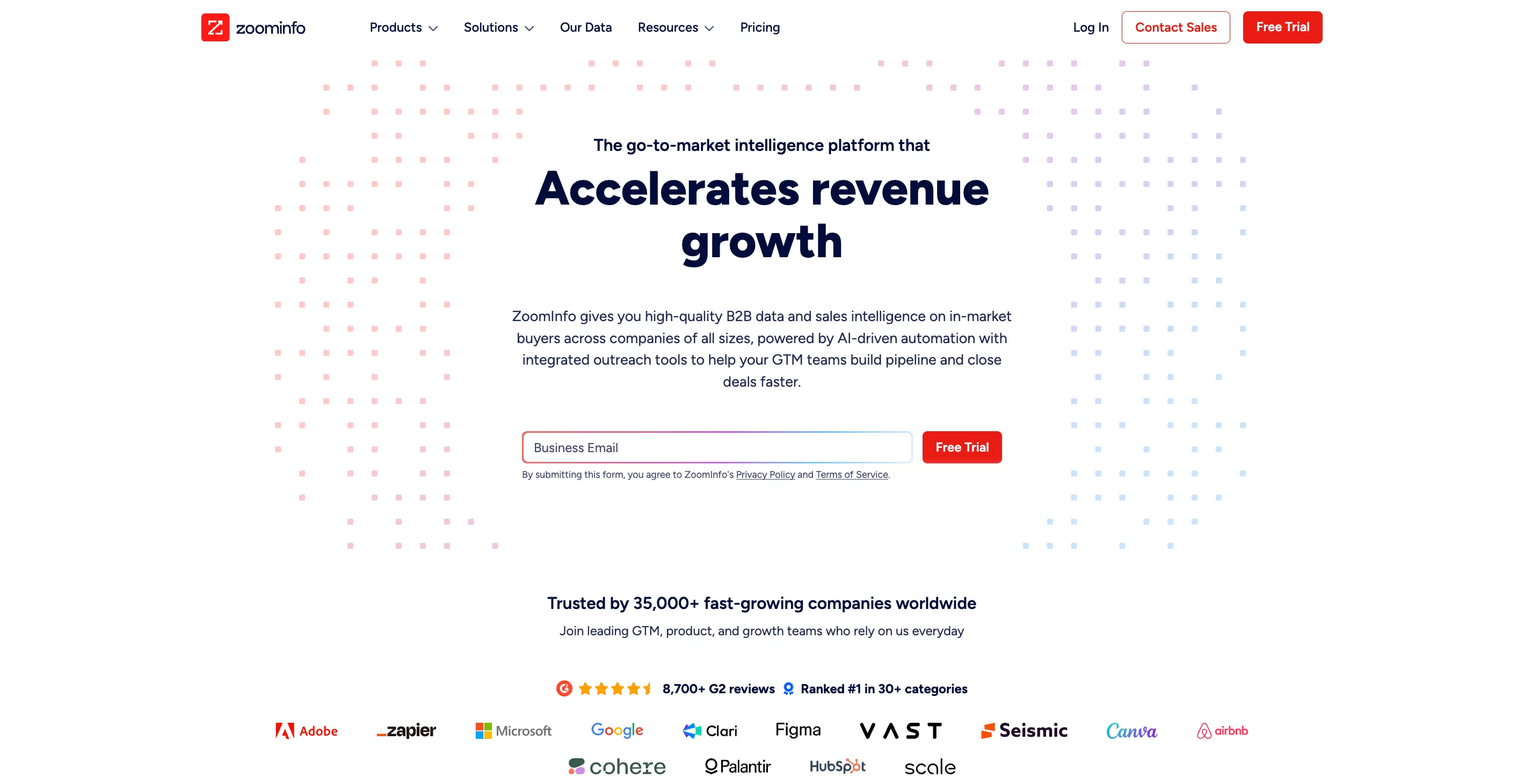
ZoomInfo is the gold standard for B2B contact data, offering deep firmographics, technographics, and intent signals on millions of companies. It's built for enterprise sales teams that need accurate, up-to-date information on decision-makers at large organizations.
Key Features:
- Comprehensive contact database with direct dials and verified emails
- Intent data showing active buying signals
- Technographic insights (what tech stack prospects use)
- Native integrations with Salesforce, Outreach, and other sales tools
Unique Strengths: ZoomInfo's data accuracy and coverage are unmatched, especially for large companies. The intent data helps prioritize accounts showing active buying behavior.
Weaknesses: ZoomInfo is a data platform, not an execution tool. You still need separate systems for outreach, sequencing, and follow-ups. Pricing is high, and smaller teams may find it cost-prohibitive.
Best Fit: Enterprise sales teams with dedicated SDRs and account executives who need high-quality data to fuel manual or semi-automated prospecting workflows.
Comparison: ZoomInfo provides the intelligence layer but requires integration with tools like Outreach or SalesLoft for execution. 11x combines data intelligence with autonomous outreach, eliminating the need for multiple platforms.
Pricing: Custom enterprise pricing, typically starting at $15K+ annually.
Cognism

Cognism offers B2B contact data with a focus on GDPR compliance, making it ideal for enterprise teams prospecting into European markets. It provides phone-verified mobile numbers and intent data to prioritize high-value accounts.
Key Features:
- GDPR-compliant contact data
- Phone-verified mobile numbers for decision-makers
- Intent data and technographic insights
- Integrations with Salesforce, HubSpot, and Outreach
Unique Strengths: Cognism's compliance focus and phone-verified data make it a strong choice for teams targeting large organizations in regulated industries or international markets.
Weaknesses: Like ZoomInfo, Cognism is a data provider, not an execution platform. You'll need additional tools for outreach and automation.
Best Fit: Enterprise sales teams prospecting into Europe or industries with strict data privacy requirements.
Comparison: Cognism and ZoomInfo are comparable in data quality, but Cognism's GDPR compliance gives it an edge for international prospecting. 11x integrates with both platforms to enrich its autonomous outreach workflows.
Pricing: Custom pricing based on data volume and features.
Apollo.io

Apollo.io combines a B2B database with email sequencing and engagement tracking, offering an affordable all-in-one solution for mid-market and growing enterprise teams.
Key Features:
- 250M+ contact database
- Email sequencing and automation
- Engagement tracking and analytics
- Chrome extension for LinkedIn prospecting
Unique Strengths: Apollo's pricing is accessible for smaller teams, and its all-in-one approach reduces tool sprawl. The platform is easy to set up and use.
Weaknesses: Data accuracy lags behind ZoomInfo and Cognism, especially for enterprise accounts. Automation is limited to basic sequencing—no AI-driven personalization or autonomous execution.
Best Fit: Mid-market sales teams or early-stage enterprise programs that need an affordable, easy-to-use prospecting platform.
Comparison: Apollo is a solid entry-level tool, but it lacks the data depth and AI sophistication required for complex enterprise prospecting. Teams scaling into enterprise should consider upgrading to 11x for autonomous execution or ZoomInfo for data quality.
Pricing: Free plan available; paid plans start at $49/user/month.
Regie.ai

Regie.ai uses generative AI to create personalized email sequences and LinkedIn messages at scale. It's designed for sales teams that want to automate content creation while maintaining human oversight.
Key Features:
- AI-generated email and LinkedIn messaging
- A/B testing and performance analytics
- Integration with Outreach, SalesLoft, and CRMs
Unique Strengths: Regie.ai excels at generating account-specific messaging frameworks quickly, reducing the time reps spend writing emails.
Weaknesses: Regie.ai generates content but doesn't execute outreach autonomously. Reps still need to review, approve, and send messages manually. It's a productivity tool, not a replacement for SDR headcount.
Best Fit: Enterprise sales teams with existing SDR capacity who want to accelerate content creation and improve messaging quality.
Comparison: Regie.ai is a content layer, not a full prospecting platform. 11x goes further by autonomously executing the entire outreach workflow, research, personalization, sending, and follow-ups, without human intervention.
Pricing: Custom enterprise pricing
LinkedIn Sales Navigator
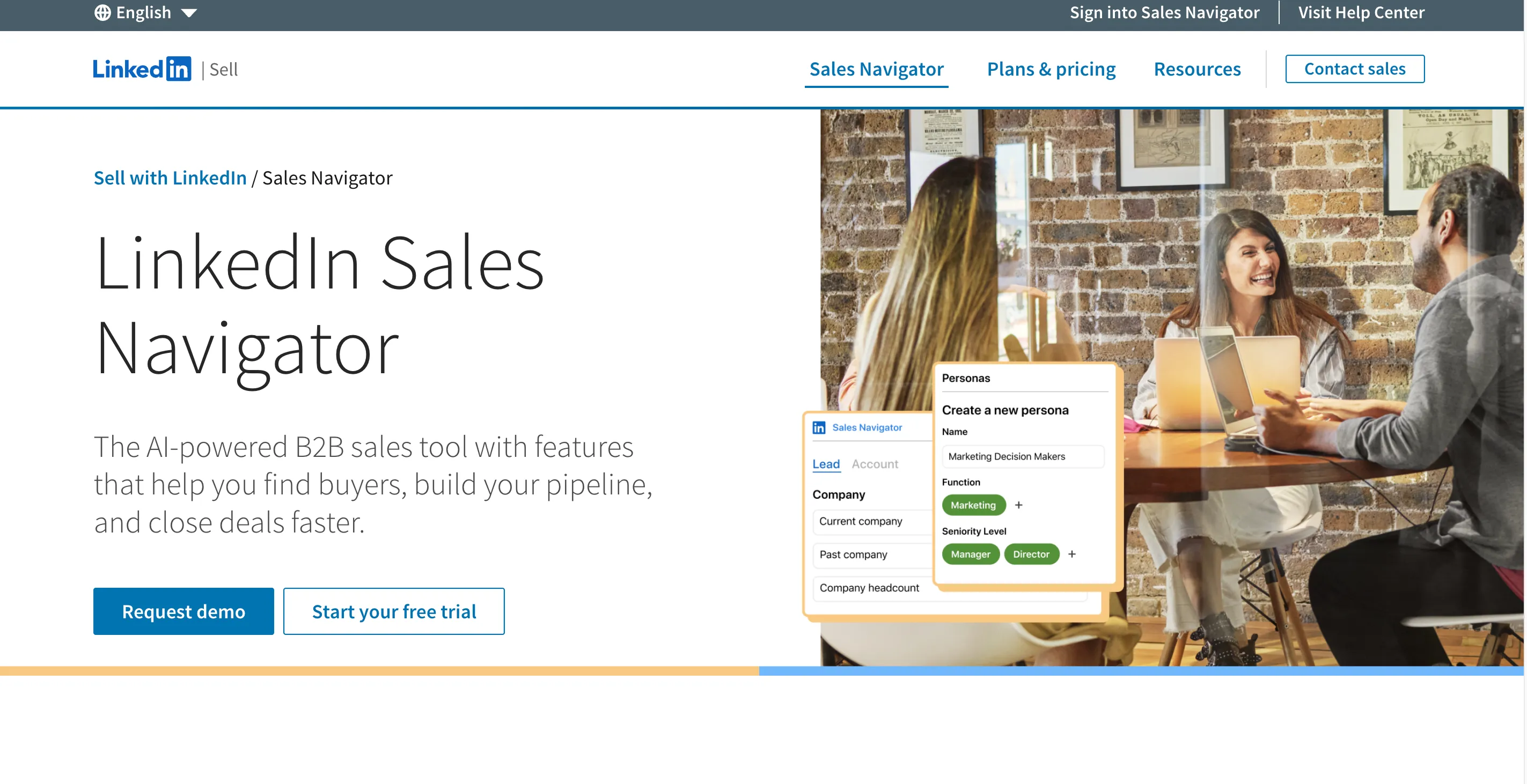
LinkedIn Sales Navigator remains the go-to platform for B2B relationship building and account research. Its enterprise edition is designed for teams targeting large organizations, making it a crucial component in any enterprise prospecting stack.
Key Features:
- Advanced search filters for company size, seniority level, geography, and function
- Real-time buyer intent through engagement alerts and “Account News” updates
- Integration with CRMs like Salesforce and HubSpot for seamless data sync
- TeamLink and shared network visibility to find warm introductions into target accounts
Unique Strengths: Sales Navigator is unmatched for identifying and engaging key decision-makers. Its insights into shared connections and activity on the platform allow enterprise sales teams to build trust and credibility before the first outreach message is sent.
Weaknesses: Sales Navigator doesn’t provide automation or sequencing capabilities; it’s a research and engagement tool rather than a full execution platform. Results depend heavily on manual input and consistent use by sales reps.
Best Fit: Account executives and SDRs targeting enterprise clients who rely heavily on relationship-based selling and social proof. Sales Navigator is especially effective in the early stages of enterprise prospecting, mapping stakeholders and identifying referral paths.
Comparison: While Sales Navigator powers the research and relationship mapping layer, it requires external tools for execution. 11x extends this by turning those insights into action: Alice automatically identifies prospects surfaced via Sales Navigator and engages them through multi-channel outreach autonomously.
Pricing: Team plans start around $135/user per month, with enterprise editions offering advanced admin controls and integrations.
Building the Perfect Enterprise Prospecting Workflow
The most effective enterprise prospecting workflows integrate intelligence, automation, and human touch into one continuous motion. A typical high-performing stack looks like this:
- Data Layer: ZoomInfo or Cognism provide verified enterprise contact data and intent signals.
- CRM Layer: CRM layers such as Salesforce or HubSpot act as the operational core, connecting every engagement channel through continuous CRM data enrichment that keeps contact, intent, and activity data accurate in real time.
- Execution Layer: 11x digital workers (Alice and Julian) autonomously run outreach, qualify leads, and execute follow-ups across email, LinkedIn, and phone.
- Insight Layer: Tools like Sales Navigator and BI dashboards provide real-time visibility into engagement and forecasting.
The result is an always‑on system that feeds pipeline continuously, powered by automated lead generation workflows that connect data, orchestration, and multi‑channel execution.
11x operationalizes this model by combining intelligence, automation, and real-time execution in a unified layer that turns dormant enterprise accounts into active opportunities.
Advanced Tactics for Large-Scale Enterprise Prospecting
Multi-Threading and Stakeholder Mapping
Winning a six-figure enterprise deal requires aligning multiple internal champions. Identify at least five personas across business and technical roles. Map their influence and interactions using CRM engagement data and LinkedIn insights. AI agents like Alice thrive here, autonomously engaging stakeholders across channels while adapting tone and message based on context.
Account-Based Personalization at Scale
AI personalization engines can now tailor outreach to entire buying committees. 11x’s digital workers pull data from CRM, social signals, and website behavior to adjust tone and value propositions automatically, creating personalization at scale that still feels human.
Predictive Forecasting and Deal Prioritization
Advanced enterprise teams leverage AI analytics to forecast deal progression and prioritize outreach. By analyzing engagement signals and conversation patterns, AI agents identify which accounts are most likely to convert and double down on high-probability opportunities.
Use Customer Success for Upselling and Referrals
Your current enterprise clients are your next best prospects. Equip your customer success managers with automated playbooks powered by AI BDRs to identify expansion opportunities. This continuous motion turns closed-won deals into recurring pipeline generators.
Case Studies and Results
Leading enterprise organizations across SaaS, finance, and manufacturing have redefined their outbound engine with 11x. A global B2B SaaS company replaced a 12-person SDR team with Alice and Julian, achieving a 43% increase in qualified meetings and cutting cost per lead by 68% within three months. Another enterprise client used 11x’s digital workers to revive over 200K dormant CRM leads, generating seven enterprise demos in the first week of deployment.
The takeaway: autonomous prospecting is no longer experimental, it’s the operational backbone of enterprise GTM teams seeking speed, scale, and consistency.
The Future of Enterprise Sales Prospecting
The enterprise sales landscape is shifting from labor-based to intelligence-based execution. Manual cadences and static sequences are becoming obsolete as AI systems take control of the repetitive, data-heavy work. Enterprise success now depends on the ability to orchestrate personalized, multi-threaded, multi-channel engagement at scale, continuously, not occasionally.
11x represents that next frontier. Its autonomous digital workers transform enterprise prospecting from a manual, resource-heavy process into a self-running growth engine. By combining AI-driven research, personalization, and execution, 11x enables GTM teams to operate with precision and speed previously unattainable by human-only workflows.
Ready to see it in action?
Book a demo with 11x and watch your enterprise pipeline fill itself, autonomously, intelligently, and around the clock.
Frequently Asked Questions
The five P’s, Preparation, Personalization, Persistence, Prioritization, and Process, are the foundation of successful prospecting. AI agents like 11x’s Alice automate these pillars by researching accounts, crafting personalized outreach, maintaining follow-ups, prioritizing high-intent leads, and refining workflows over time.
This rule emphasizes focus: engage three new prospects, follow up with three current opportunities, and advance three deals daily. AI SDRs apply this discipline autonomously, tracking engagement across CRM and outreach tools in real time to maintain a balanced cadence across pipeline stages.
It states that successful selling involves listening 70% of the time and speaking 30%. In enterprise contexts, Julian, the AI phone agent, embodies this approach, analyzing sentiment and pausing strategically to capture more buyer intelligence per call.
If no response follows your initial contact, follow up in two days, two weeks, and two months. AI-driven cadence systems like 11x handle this timing automatically, ensuring no opportunity slips through while adapting frequency based on recipient behavior.
Trust is built on relevance and consistency. Enterprise SDRs must demonstrate understanding of the buyer’s initiatives and maintain steady, value-driven outreach. 11x sustains that trust automatically, ensuring every follow-up, touchpoint, and piece of communication aligns with buyer personas and account context.
.png)
.png)
.png)
.png)