Top Conversation Intelligence Platforms for AI-Driven Sales Teams in 2025
Compare the best conversation intelligence platform tools to transcribe calls, track sentiment, and turn conversations into actionable insights.
.png)

Your team has dozens of sales calls every day, and most of the insight disappears the moment the meeting ends. Conversation intelligence turns raw talk into structured data you can coach, forecast, and act on in real time.
Conversation intelligence platforms capture, transcribe, and analyze interactions across calls, email, and meetings, then push actionable insights into your CRM and engagement tools. Adoption is rising because AI delivers measurable lift: sales teams using AI are 1.3x more likely to see revenue growth, with 83% reporting growth vs 66% without AI, and 81% of teams experimenting with or fully implementing AI, according to Salesforce’s sixth State of Sales report. These systems surface sentiment, objections, and next steps while calls are in progress, then automate follow-through.
This guide maps the category, explains how the tech works, and compares leading platforms for 2025. You will see where analytics-led tools stop at insight and where autonomous execution closes the loop.
What Is a Conversation Intelligence Platform?
A conversation intelligence platform captures and analyzes customer interactions across calls, emails, and meetings using AI-driven transcription and sentiment analysis. Unlike basic call recording tools, these systems apply NLP to extract patterns, identify objections, track keywords, and generate post-call summaries automatically.
The workflow impact is immediate. Conversation data flows into Salesforce, HubSpot, or Dynamics 365, creating action items, updating deal stages, and flagging follow-up tasks without manual input. Sales managers use dashboards to benchmark agent performance, replicate what top performers do, and build playbooks grounded in real customer conversations.
Common use cases include coaching, forecasting, retention analysis, customer sentiment tracking, and sales enablement. Teams that deploy conversation intelligence software report higher conversion rates, shorter onboarding cycles, and measurable improvements in customer satisfaction.
How Does Conversation Intelligence Work?
Conversation intelligence turns messy, unstructured talk into clean, actionable data that moves through your stack in real time. The workflow is a closed loop: capture the interaction, analyze for meaning and intent, visualize what matters for leaders and coaches, then act inside your CRM and engagement tools so nothing stalls between insight and execution.
- Capture every interaction: Record and transcribe sales calls, emails, video meetings, and chat across all channels. Real-time transcription quality depends on the provider’s NLP engine, domain tuning, and language coverage.
- Analyze for intent and risk: Apply NLP to detect sentiment, keywords, objections, talk ratios, competitive mentions, and engagement cues. Machine learning correlates patterns with outcomes to flag behaviors linked to closed won or churn risk.
- Visualize performance and trends: Use dashboards for average call length, question frequency, engagement scores, pipeline velocity, and coaching benchmarks. Leaders adjust strategy and prioritize support based on live indicators rather than anecdote.
- Act with automated follow-through: Generate summaries, create tasks, update CRM fields, and surface coaching opportunities automatically. Advanced systems like 11x digital workers execute these actions autonomously, eliminating manual workflows and closing the loop.
Top 6 Conversation Intelligence Platforms in 2026
Conversation intelligence in 2026 shifts from passive insight to closed-loop execution. The six leaders here split between deep analytics for coaching-led teams and autonomous systems that act on signals in real time. Use this quick scan to match options to your motion, integration depth, security posture, and budget.
Evaluation Criteria: How We Assessed These Platforms
Our methodology prioritizes neutral, criteria-driven analysis: 90% objective feature comparisons, 10% strategic insights from GTM experience. Each platform was evaluated on:
- Enterprise readiness: Security compliance (SOC 2, GDPR, CASA), scalability, and uptime guarantees
- Integration depth: Native connections to Salesforce, HubSpot, Outreach, and other sales engagement platforms
- AI sophistication: Transcription accuracy, sentiment analysis precision, and predictive analytics capabilities
- Coverage across the sales lifecycle: Support for prospecting, qualification, closing, and retention workflows
- CRM quality: Bidirectional sync, custom field mapping, and automated data enrichment
- Governance features: Role-based access, audit trails, and compliance reporting
- Measurable ROI: Documented impact on conversion rates, deal velocity, and customer retention
Comparison Overview of the Top Conversation Intelligence Platforms
Use this at‑a‑glance grid to shortlist by workflow fit. Data types and accuracy indicate capture quality, key integrations reveal CRM and engagement alignment, automation level shows whether the tool only informs or also executes, and pricing range frames total cost. Start with your primary motion, then filter for integration fit, governance needs, and automation depth.
11x
11x provides two autonomous AI sales agents: Alice for outbound prospecting and Julian for inbound phone qualification. Together, they function as digital workers that manage research, outreach, lead engagement, and qualification without human intervention. Their continuous operation gives teams a programmable SDR function that runs 24/7 and feeds accurate activity data into existing CRM systems.
11x Key Features:
- Alice (AI SDR): Conducts outbound prospecting across email and LinkedIn to secure qualified meetings.
- Julian (AI Phone Agent): Calls inbound leads within seconds and qualifies them through natural two-way conversations.
- Autonomous Operation: Completes research, outreach, follow-ups, and lead qualification independently.
- CRM Integration: Syncs with Salesforce, HubSpot, and Microsoft Dynamics 365 to maintain clean activity logs and forecasting signals.
- Global Language Support: Engages prospects in more than 100 languages with real-time transcription and sentiment analysis.
Pros and Cons of 11x
11x Best Fit:
11x is ideal for GTM teams, replacing SDR and contact-center tasks with continuous AI execution. Compared to assistive tools, 11x autonomously identifies, engages, and qualifies leads across outbound and inbound workflows.
11x Pricing:
Custom enterprise plan with usage-based tiers tied to lead volume and integration scope.
Gong
Gong is a conversation and revenue intelligence platform that delivers full-funnel visibility across calls, emails, and meetings. It analyzes interactions for deal risk and coaching insights, helping leaders forecast accurately and scale top-performer behaviors.
Gong Key Features:
- Revenue Intelligence Dashboards: Track pipeline health, deal progression, and forecast accuracy.
- Predictive Analytics: Identify deal risks using talk ratios, questions, and competitive mentions.
- Coaching Insights: Surface patterns that improve discovery and objection handling.
- Broad Integrations: Salesforce, HubSpot, Outreach, Salesloft, Zoom, Slack.
- Automated Capture and Transcription: Record and transcribe interactions with near real-time CRM enrichment.
Pros and Cons of Gong
Gong Best Fit:
Enterprise organizations with complex cycles and a coaching-led culture that prioritizes forecast precision and scalable enablement.
Gong Pricing:
Custom enterprise pricing, commonly about $1,200 to $1,800 per user annually in mid-market deployments.
Chorus (ZoomInfo)
Chorus focuses on real-time transcription and coaching signals, highlighting sentiment shifts, objections, and next steps during live calls. Post-call notes and highlights sync to your CRM to streamline follow-up and coaching.
Chorus Key Features:
- Live Conversation Analytics: In-call sentiment shifts, keyword triggers, and talk-time balance.
- Automated Notes and Highlights: Post-call summaries with key moments and action items.
- Coaching Dashboards: Identify skill gaps and track improvement across teams.
- ZoomInfo Enrichment: Add firmographic context for better targeting and messaging.
- CRM and Engagement Integrations: Salesforce, HubSpot, Microsoft Dynamics 365, Outreach, Salesloft.
Pros and Cons of Chorus
Chorus Best Fit:
Mid-market teams prioritizing real-time coaching and already invested in the ZoomInfo ecosystem.
Chorus Pricing:
Often bundled with ZoomInfo or available standalone, typically about $1,000 to $1,500 per user annually.
Invoca
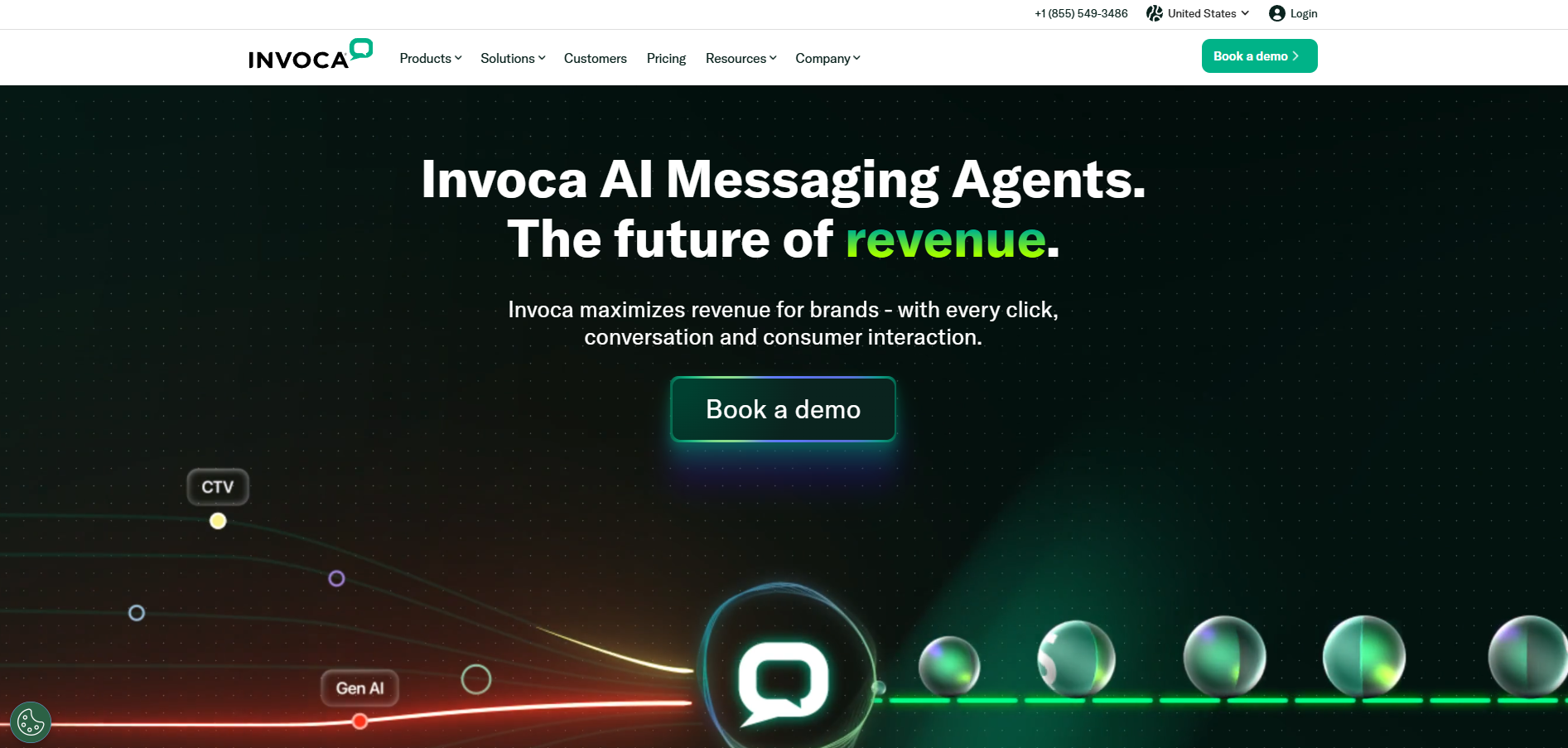
Invoca specializes in phone call analytics and marketing attribution for contact centers and campaign-driven funnels. It connects call outcomes to media spend and routes high-value calls to the right agents.
Invoca Key Features:
- AI Transcription and Sentiment: Extract needs, pain points, and satisfaction from calls.
- Signal AI and Routing: Detect buying intent and direct calls to best-fit agents.
- Marketing Attribution: Tie revenue and conversions back to campaigns and keywords.
- Advertising and Analytics Integrations: Google and Adobe stacks, plus CRM and call center platforms.
- API for Custom Workflows: Build attribution and routing logic into your systems.
Pros and Cons of Invoca
Invoca Best Fit:
Marketing-led organizations, call centers, and businesses where inbound phone calls drive a large share of pipeline and revenue.
Invoca Pricing:
Custom enterprise pricing based on volume and features, often about $30,000 to $100,000 annually.
Claap
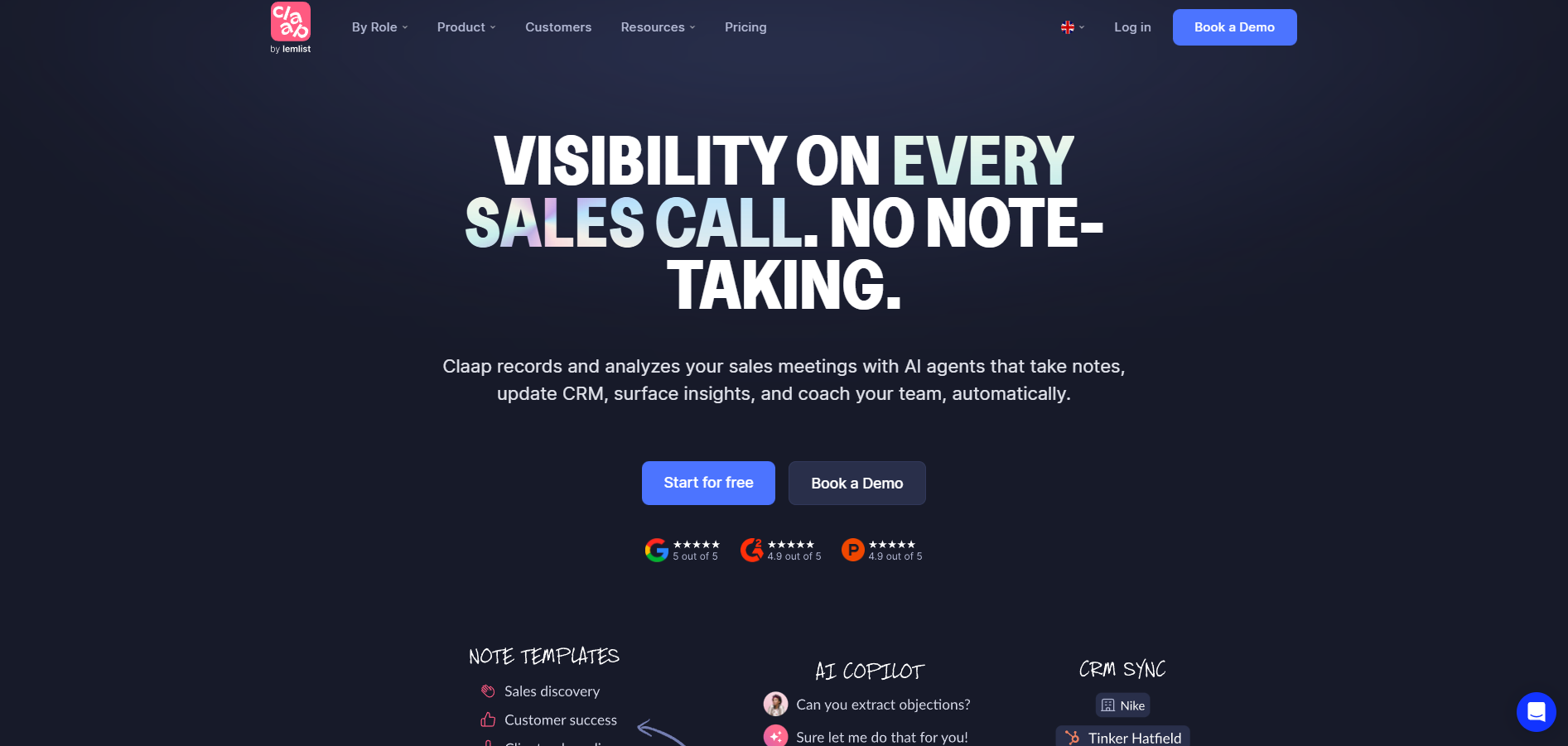
Claap is a lightweight meeting recording and summarization tool designed for async collaboration. It emphasizes highlights, comments, and quick review rather than deep CRM-driven analytics.
Claap Key Features:
- Automatic Transcription and Notes: Works with Zoom, Google Meet, and Microsoft Teams.
- Shareable Highlights and Snippets: Review key moments without full replays.
- Timestamped Comments: Enable asynchronous feedback and coaching.
- Collaboration Integrations: Slack, Notion, and Asana.
- Simple Insights: Collaboration-first with limited CRM sync and governance.
Pros and Cons of Claap
Claap Best Fit:
Startups and remote teams seeking basic transcription and collaborative review without enterprise complexity.
Claap Pricing:
Free plan available. Paid tiers generally range from about $10 to $30 per user per month.
Outreach
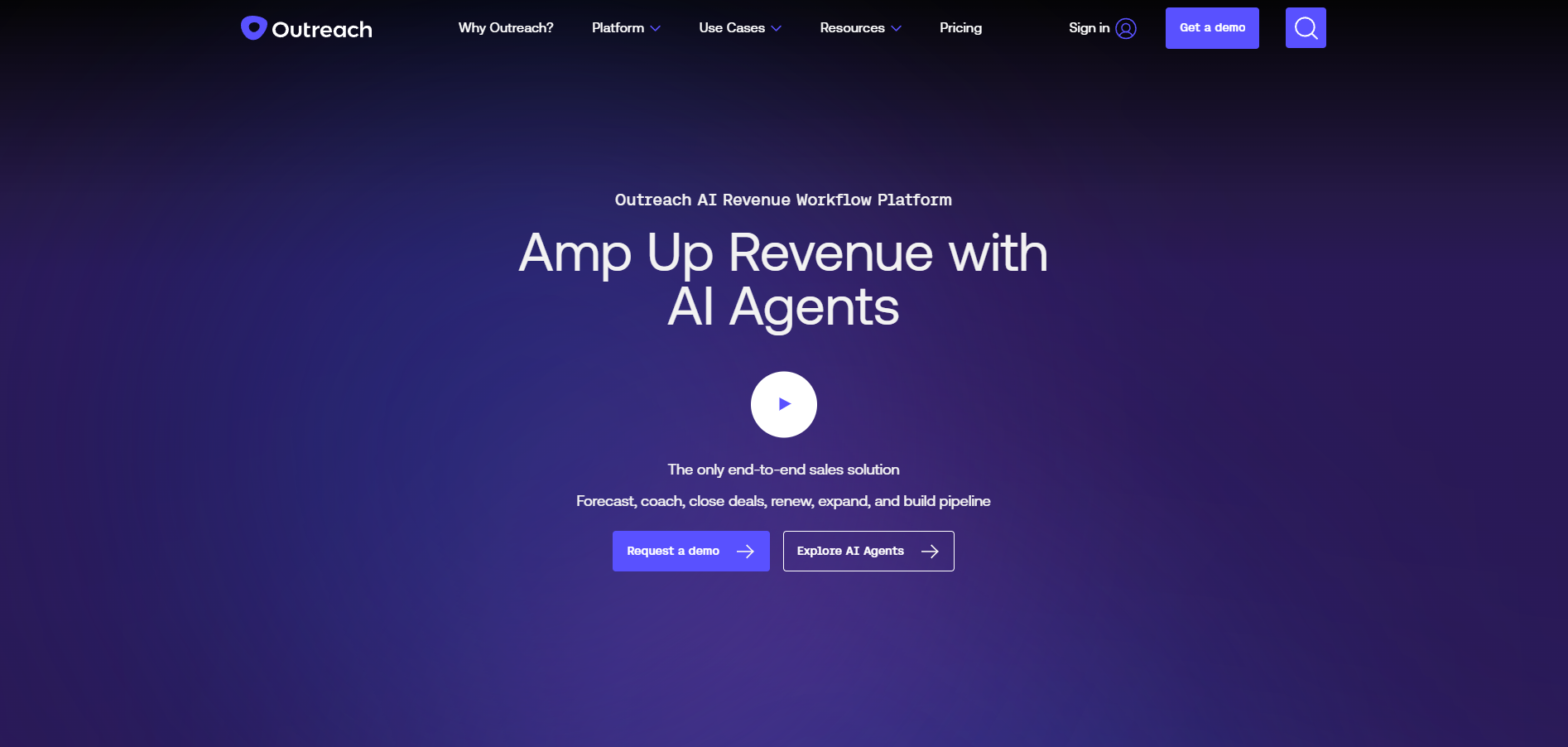
Outreach is a sales engagement platform with embedded conversation intelligence that ties insights directly to cadence execution. It unifies prospecting, follow-up, and deal progression inside one workflow.
Outreach Key Features:
- In-Platform CI: AI transcription and sentiment integrated with sequences.
- Next-Best-Action: Recommendations informed by conversation and cadence data.
- Performance Dashboards: Track response rates, objections, and pipeline velocity.
- Native CRM Sync: Salesforce and Microsoft Dynamics 365 for clean activity capture.
- Ecosystem Connectors: Integrations with LinkedIn Sales Navigator and partner tools.
Pros and Cons of Outreach
Outreach Best Fit:
Mid-market and enterprise teams running sales engagement at scale who want conversation insights embedded in cadence workflows.
Outreach Pricing:
Custom enterprise pricing, often about $100 to $150 per user per month for full platform access.
Avoma
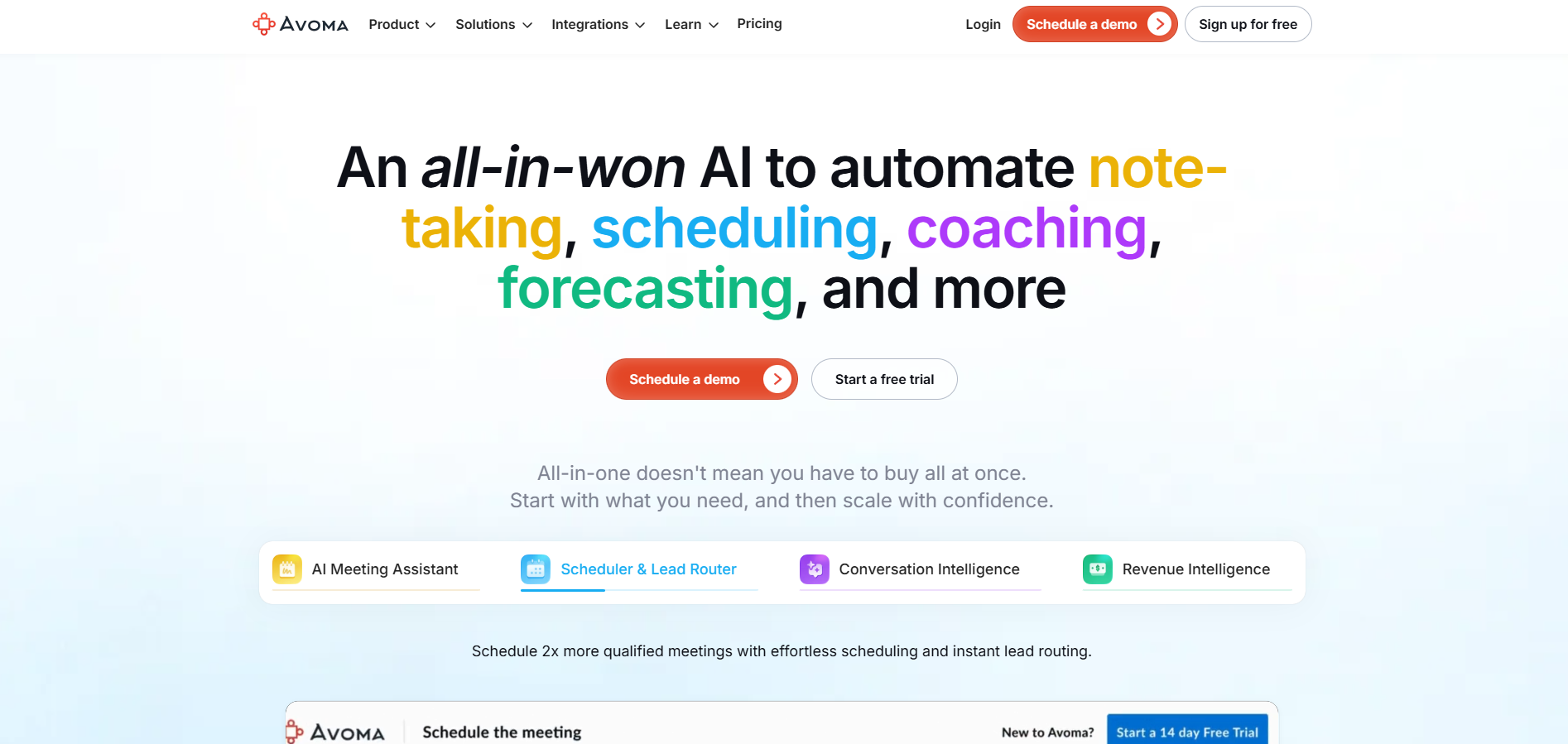
Avoma delivers affordable conversation intelligence for SMB and mid-market teams with strong meeting transcription, AI summaries, and coaching workflows. It emphasizes quick deployment and ease of use.
Avoma Key Features:
- Real-Time Transcription: Keyword detection and sentiment tracking.
- AI Summaries and Action Items: Post-call notes that accelerate follow-up.
- Coaching and Playbooks: Build and share best practices from call insights.
- Integrations: Salesforce, HubSpot, Pipedrive, Zoom, Google Meet, Microsoft Teams.
- API Support: Lightweight customization for smaller stacks.
Pros and Cons of Avoma
Avoma Best Fit:
SMBs and startups seeking core CI functions and coaching without enterprise complexity.
Avoma Pricing:
Free plan available. Paid tiers typically range from about $19 to $79 per user per month.
Salesloft
Salesloft integrates conversation intelligence into its engagement platform to connect call data with cadences and pipeline metrics. It focuses on operational execution informed by conversation outcomes.
Salesloft Key Features:
- AI Transcription and Sentiment: Feed insights into the Rhythm engine for next actions.
- Workflow Automation: Automate follow-ups based on conversation signals.
- Performance Dashboards: Track conversion rates, objections, and deal velocity.
- CRM Integrations: Bidirectional sync with Salesforce and Microsoft Dynamics 365.
- LinkedIn Integration: Align outreach and engagement across channels.
Pros and Cons of Salesloft
Salesloft Best Fit:
Mid-market and enterprise teams standardizing on Salesloft that want embedded conversation insights to optimize cadences.
Salesloft Pricing:
Custom enterprise pricing, typically about $100 to $125 per user per month.
Benefits of Using a Conversation Intelligence Platform
Conversation intelligence platforms deliver measurable ROI across multiple dimensions:
- Automate routine workflows: Transcription, data entry, and note-taking happen automatically, freeing reps to focus on customer conversations rather than administrative tasks. Teams report saving 5–10 hours per rep per week.
- Improve coaching opportunities: Quantified metrics on talk ratios, objection handling, and question frequency enable targeted coaching. Sales managers identify skill gaps faster and replicate top performer behaviors across the team.
- Enhance customer experience: Sentiment tracking and proactive follow-ups reduce churn and improve satisfaction scores. Conversation data reveals pain points before they escalate, enabling preemptive action.
- Empower sales leaders: Dashboard-level insights surface which deals are at risk, which reps need support, and which strategies drive the highest conversion rates. Forecasting accuracy improves when conversation data informs pipeline predictions.
- Drive measurable ROI: Organizations using conversation intelligence report 15–30% improvements in conversion rates, 20–40% reductions in onboarding time, and 10–25% increases in customer retention.
How to Choose a Conversation Intelligence Platform
Pick for your motion. Use the checks below to shortlist tools that fit your workflows, compliance needs, and scale.
- Real-time insights that drive action: Confirm live sentiment tracking and in-call alerts for objections, competitive mentions, and buying signals. You want immediate prompts and post-call alerts that translate into next steps.
- Transcription quality and language coverage: Evaluate accuracy, speed, and domain handling in your environment. Target 95% or better accuracy and verify support for your team’s languages.
- Reporting that mirrors your KPIs: Require customizable dashboards and filters so you can track team performance, funnel metrics, and conversation outcomes against your scorecard. Avoid rigid, one-size-fits-all analytics.
- Integrations and orchestration: Insist on native connections to Salesforce, HubSpot, and Dynamics 365, plus your sales engagement platform. Data should sync bidirectionally without manual exports.
- Security and compliance posture: Validate SOC 2, GDPR, and CASA coverage. Review data retention policies and encryption standards to meet enterprise requirements.
- Scalability and cost curve: Load-test for growing call volumes and distributed teams. The platform should scale without performance degradation or unexpected cost spikes.
How AI-Powered Conversation Intelligence Drives Measurable Sales Performance
Conversation analytics turns unstructured talk into structured, searchable data tied directly to the pipeline. When transcripts, sentiment, and engagement signals land in your CRM and engagement tools in real time, you connect behaviors to outcomes, prioritize next best actions, and automate follow-through with confidence. The impact concentrates in six levers you can measure and improve: revenue coverage, forecast accuracy, enablement quality, coaching efficiency, retention risk, and pipeline velocity.
- Revenue metrics: Platforms correlate conversation patterns with closed deals, revealing which behaviors drive revenue. Sales leaders use this data to adjust coaching priorities and refine sales strategies.
- Forecasting models: Sentiment analysis and engagement scores predict deal outcomes more accurately than stage-based forecasting alone. Teams that incorporate conversation data into forecasts report 20–30% accuracy improvements.
- Sales enablement: Real-time analysis helps teams refine messaging and objection handling dynamically, ensuring consistent performance across every rep. AI-driven post-call summaries identify exactly which talking points resonate with customers and which lead to stalls.
- Coaching efficiency: Managers move from anecdotal feedback to evidence-based development. Conversation intelligence scores each interaction, allowing leaders to prioritize coaching sessions with the highest impact potential.
- Customer retention: Sentiment tracking uncovers dissatisfaction before it becomes churn. AI models detect emotional cues like frustration or disinterest, prompting timely intervention. 11x’s digital workers extend this further by taking action automatically—triggering follow-ups, escalating cases, or sharing feedback with customer success teams in real time.
- Pipeline acceleration: Accurate transcription and instant CRM updates remove friction between conversation and execution. When every customer exchange feeds directly into workflow automation, deal cycles shorten and engagement touchpoints increase without adding headcount.
Turn every conversation into revenue with 11x
Conversation intelligence makes customer interactions measurable and actionable, improving coaching, forecasting, and execution. The leaders differ by analytics depth, automation, and integration fidelity, so the right choice depends on your mission and operating model.
11x closes the loop by pairing insight with autonomous action. Alice and Julian capture every exchange, auto-summarize, update Salesforce or HubSpot, and follow up instantly so no signal is lost. With enterprise-grade security and deep integrations, you consolidate tools while raising speed-to-lead and pipeline coverage.
Ready to turn every call into next steps, automatically? Explore 11x to see how digital workers convert conversation data into booked meetings and qualified revenue.
Frequently Asked Questions
Frequently Asked Questions
How do conversation intelligence tools improve sales performance?
They convert every customer interaction into measurable data. AI correlations between talk patterns, sentiment, and outcome identify exactly what drives conversions. At 11x, digital workers take this one step further—executing follow-ups and CRM updates automatically, turning insights into closed deals without manual effort.
What’s the difference between conversation intelligence and call recording?
Call recording archives interactions; conversation intelligence interprets them. The addition of natural language processing and machine learning transforms static recordings into structured analytics. 11x’s platform extends analysis into execution, letting AI agents act on insights in real time.
Which teams benefit most from conversation intelligence?
Sales, RevOps, and Customer Success teams gain the most immediate ROI. Reps improve call quality, leaders refine enablement, and RevOps automates CRM hygiene. 11x’s AI SDRs and phone agents run these processes continuously, improving performance at scale across time zones and languages.
How accurate is AI transcription in 2025?
The best providers deliver over 95% accuracy, aided by domain-specific NLP models. Multilingual capabilities now support over 100 languages. 11x’s transcription engine powers this range globally, enabling consistent analysis for multi-regional sales teams.
Can conversation intelligence tools replace manual data entry entirely?
Yes, with the most advanced providers. Systems like 11x’s digital workers close the loop by creating tasks, updating CRM fields, and triggering next steps autonomously. The outcome is zero manual input and fully integrated revenue execution.