The Top Lead Scoring Software: 2026 Comparison
Learn how modern lead scoring software prioritizes buyers, shortens sales cycles, and improves conversion rates.


Your sales rep just spent three hours calling 47 inbound leads. Only two showed genuine interest, and one had already bought from a competitor last month. Meanwhile, the highest-converting prospect from last quarter sat unnoticed in your CRM for six days before anyone reached out.
Lead scoring software transforms this chaotic process by automatically ranking prospects based on demographic data, firmographic information, and behavioral signals like email opens, website visits, and CRM engagement patterns. According to Forbes, companies with aligned sales and marketing teams see 36% higher customer retention rates and generate 208% more revenue from marketing efforts when using systematic lead qualification. These systems help marketing teams prioritize outreach while enabling sales reps to follow up with qualified leads in real-time.
This guide compares six leading lead scoring platforms based on automation depth, CRM integrations, data enrichment capabilities, and measurable ROI outcomes. You'll discover which platform best fits your sales process and team size.
The Top Lead Scoring Tools: 2026 Comparison
Our methodology prioritizes neutral, criteria-driven analysis. The evaluation is 90 percent objective feature comparisons and 10 percent strategic insights from our go-to-market experience. Each platform was assessed on its ability to accelerate the sales pipeline, not just manage it.
Key evaluation factors include:
- Automation Depth: Task independence—from rule-based workflow to self-learning autonomy.
- Sales Cycle Coverage: Support for each funnel stage—from prospecting to handoff.
- Data Handling and Enrichment: Ability to unify and enhance data in real time.
- Integration Ecosystem: Breadth and strength of API and CRM connections.
- Measurable ROI: Documented impact on conversion, sales-cycle time, and lead cost.
Comparison of Data Types, Accuracy, Integrations, Automation Capabilities, and Pricing
11x
11x provides autonomous sales agents that handle lead qualification and follow-up without manual intervention. The platform deploys AI agents Alice (outbound) and Julian (inbound) to score, prioritize, and engage qualified leads across your entire sales pipeline. It serves marketing teams and sales reps who need real-time lead scoring that triggers immediate action rather than static prioritization lists. Pricing operates on custom plans based on AI module requirements and lead volume.
The system processes demographic, firmographic, and behavioral signals including email opens, website visits, social media engagement, and CRM activity to generate real-time lead scores. AI agents then execute personalized follow-ups, schedule meetings, and update your CRM with enriched lead data. Native integrations with Salesforce, HubSpot, and ActiveCampaign ensure seamless data flow across your sales and marketing tools. Unlike traditional lead scoring systems that require constant rule adjustments, 11x's machine learning algorithms adapt scoring models automatically based on your closed-won patterns and customer profile data.
Pros and Cons of 11x:
11x Best Fit and Comparison:
11x excels for marketing teams and sales organizations seeking autonomous lead qualification that scales without additional headcount. While rule-based systems like HubSpot require constant optimization, 11x's AI continuously refines scoring accuracy and execution strategies. The platform particularly outperforms traditional tools when handling high-volume lead generation campaigns that demand immediate, personalized responses. For teams exploring how AI transforms qualification workflows, see 7 ways AI lead qualification transforms your GTM strategy.
11x Pricing:
Custom plans based on AI modules and usage scope.
HubSpot Marketing Hub
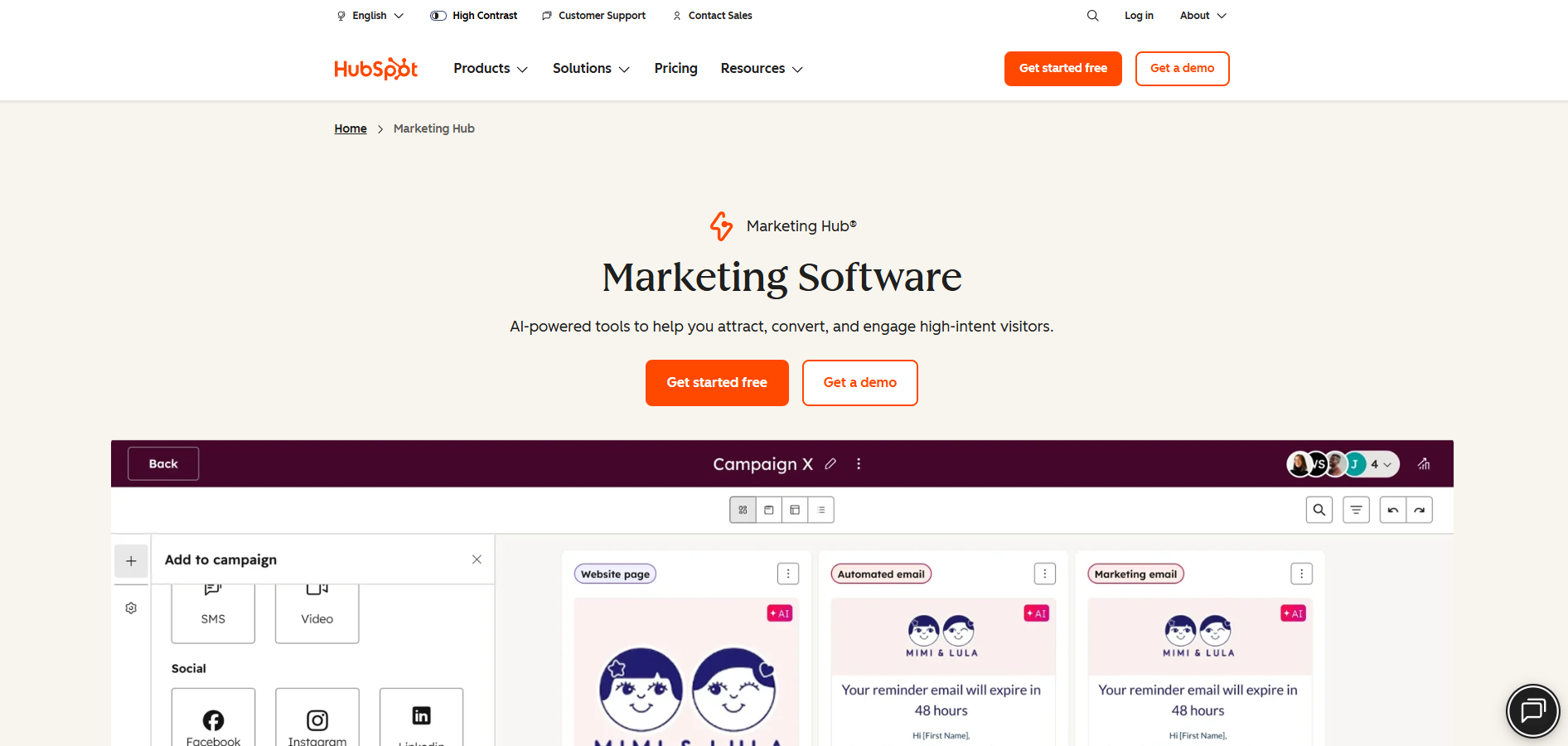
HubSpot Marketing Hub combines lead scoring with comprehensive marketing automation across email campaigns, landing pages, and social media management. The platform offers both manual scoring rules and predictive lead scoring powered by machine learning algorithms that analyze contact behavior, demographic data, and engagement patterns. It serves small businesses to mid-market companies wanting integrated marketing automation with lead scoring functionality. Pricing ranges across Starter, Professional, and Enterprise tiers with predictive scoring available on Professional level and above.
Sales teams can customize scoring criteria based on website visits, email opens, form submissions, and firmographic attributes. The system integrates natively with HubSpot CRM while connecting to thousands of third-party applications through its app marketplace. Marketing teams can create automated workflows that trigger follow-ups, assign leads to sales reps, and update contact properties based on scoring thresholds. The platform includes templates for common scoring models and provides dashboard analytics for tracking conversion rates and pipeline velocity across different lead sources.
Pros and Cons of HubSpot Marketing Hub:
HubSpot Marketing Hub Best Fit and Comparison:
HubSpot lead scoring suits small businesses to mid-market companies wanting integrated marketing automation with lead scoring functionality. The platform provides more comprehensive marketing features than specialized scoring tools like Breadcrumbs.io but requires higher investment. For teams already using HubSpot CRM or needing extensive email marketing capabilities, the unified ecosystem offers significant workflow advantages. Compared to 11x, HubSpot requires manual workflow setup and lacks autonomous execution of follow-up sequences.
HubSpot Marketing Hub Pricing:
Starts at $800 per month for Professional plans with predictive scoring.
Breadcrumbs.io
Breadcrumbs.io specializes in machine learning-powered lead scoring with custom algorithms tailored to your specific sales process and customer data. The platform analyzes firmographic, technographic, and behavioral signals to create scoring models that adapt to your ideal customer profile. It serves mid-market to enterprise sales teams with enough historical data to train effective machine learning models. Pricing operates on multiple plan levels based on contact volume and feature requirements.
Unlike generic scoring templates, Breadcrumbs builds unique models based on your historical win/loss patterns and can incorporate data from multiple sources including enrichment tools and intent platforms. The system provides real-time lead scoring updates and connects with major CRMs including Salesforce, HubSpot, and Pipedrive through native integrations. Marketing teams can segment leads based on scoring ranges, automate lead routing to appropriate sales reps, and track scoring accuracy against actual conversion outcomes. The platform includes advanced features like account-level scoring for ABM campaigns and custom scoring rules for different product lines or market segments.
Pros and Cons of Breadcrumbs.io:
Breadcrumbs.io Best Fit and Comparison:
Breadcrumbs.io fits best for mid-market to enterprise sales teams with enough historical data to train effective machine learning models. The platform offers more sophisticated scoring than HubSpot's built-in functionality while remaining more focused than enterprise solutions like Marketo. Sales organizations focused specifically on lead qualification rather than comprehensive marketing automation will find strong value in the specialized approach. Compared to 11x, Breadcrumbs provides advanced scoring logic but does not automate the outreach and follow-up actions that convert scores into revenue.
Breadcrumbs.io Pricing:
Plans start at $499 per month based on contacts and features.
Salesmate
Salesmate combines CRM functionality with assisted lead scoring and automated follow-up capabilities designed for small to medium sales teams. The platform automatically scores leads based on email engagement, phone interactions, meeting attendance, and demographic data while providing sales reps with prioritized contact lists and suggested next actions. It serves small businesses and growing sales teams that need combined CRM and lead scoring functionality without enterprise complexity. Pricing operates on per-user monthly plans with different feature tiers available.
Built-in automation workflows can trigger follow-ups, assign leads, and update contact records based on scoring changes. The system includes email marketing tools, landing page builders, and phone dialer functionality alongside lead scoring capabilities. Salesmate's algorithms analyze lead behavior patterns to predict likelihood to convert and recommend optimal contact timing and messaging approaches. The platform integrates with hundreds of applications through Zapier connections and provides native links to popular tools like ActiveCampaign, Mailchimp, and social media platforms.
Pros and Cons of Salesmate:
Salesmate Best Fit and Comparison:
Salesmate works well for small businesses and growing sales teams that need combined CRM and lead scoring functionality without enterprise complexity. The platform provides more integrated features than standalone scoring tools while maintaining easier usability than comprehensive solutions like HubSpot. Teams prioritizing ease of use and quick implementation over advanced capabilities will appreciate the streamlined approach. Compared to 11x, Salesmate offers basic scoring and CRM features but lacks autonomous AI agents that execute qualification and outreach automatically.
Salesmate Pricing:
Starts at $29 per user per month.
Outfunnel
Outfunnel focuses on bridging marketing automation platforms with CRM systems through automated lead scoring and data synchronization. The platform specializes in connecting email marketing tools like ActiveCampaign, Mailchimp, and Campaign Monitor with CRMs including HubSpot, Salesforce, and Pipedrive. It serves small businesses and marketing teams already invested in separate email marketing and CRM platforms who need better integration and basic lead scoring. Pricing operates on monthly subscription tiers based on contact volume and integration requirements.
Outfunnel automatically scores leads based on email engagement, landing page visits, and website behavior while ensuring consistent data flow between marketing and sales systems. The system creates automated workflows that update lead scores in real-time and trigger appropriate follow-up actions based on engagement levels. Marketing teams can track email campaign performance directly in their CRM while sales reps receive enriched contact records with behavioral scoring data. The platform emphasizes seamless integration and data consistency rather than complex machine learning algorithms, making it accessible for teams without technical expertise.
Pros and Cons of Outfunnel:
Outfunnel Best Fit and Comparison:
Outfunnel serves small businesses and marketing teams already invested in separate email marketing and CRM platforms who need better integration and basic lead scoring. The platform offers simpler implementation than comprehensive solutions while providing essential scoring functionality. Teams seeking sophisticated machine learning-powered scoring should consider more advanced platforms, but Outfunnel excels at solving integration challenges for existing tool stacks. Compared to 11x, Outfunnel provides data synchronization and basic scoring but lacks autonomous agents that execute qualification and engagement workflows.
Outfunnel Pricing:
Starts at $49 per month based on contacts.
Marketo Engage
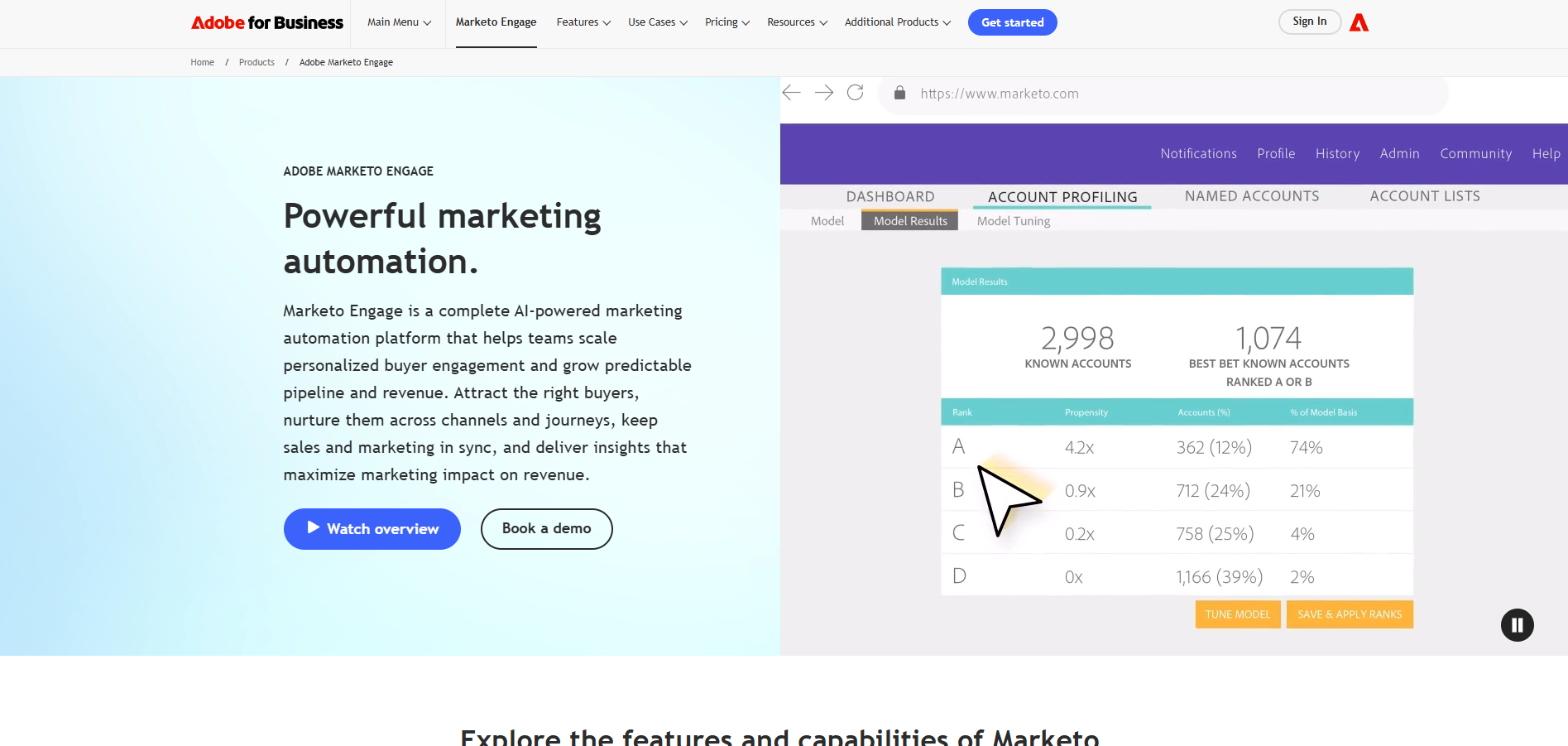
Marketo Engage delivers enterprise-level lead scoring through advanced predictive analytics and comprehensive marketing automation capabilities. The platform analyzes multi-channel touchpoints including email, web, social media, and account-based marketing activities to generate sophisticated lead and account scores. It serves large enterprises and sophisticated marketing organizations with complex sales processes requiring advanced automation and scoring capabilities. Pricing operates on enterprise-level plans with costs scaling based on database size and feature requirements.
Marketo's machine learning algorithms process demographic, firmographic, and behavioral data to predict conversion probability and optimal engagement timing across complex sales cycles. The system integrates deeply with Salesforce and Microsoft Dynamics while supporting extensive third-party connections for data enrichment and campaign execution. Marketing teams can create intricate scoring models that account for multiple products, geographic markets, and buyer personas while automating lead nurturing sequences based on score changes. Enterprise features include account-based scoring for ABM campaigns, revenue attribution modeling, and advanced segmentation capabilities for large-scale marketing operations.
Pros and Cons of Salesforce:
Salesforce Best Fit and Comparison:
Salesforce lead scoring through Marketo fits large enterprises and sophisticated marketing organizations with complex sales processes requiring advanced automation and scoring capabilities. The platform provides more comprehensive features than mid-market solutions like HubSpot while offering deeper integration than specialized tools. Organizations with dedicated marketing operations teams and enterprise-level lead volumes will maximize Marketo's sophisticated functionality. Compared to 11x, Marketo offers broader marketing automation but requires manual execution of sales tasks rather than autonomous AI agents.
Salesforce Pricing:
Enterprise pricing available upon request.
Transform Lead Qualification into Revenue Acceleration
Lead scoring software has become critical for modern sales organizations to prioritize the right leads, shorten sales cycles, and improve conversion rates. The tools reviewed here span from lightweight CRM add-ons to enterprise AI platforms that analyze millions of data points in real time.
11x goes beyond scoring by executing on it. Its AI agents turn lead data into action, qualifying, engaging, and following up autonomously to convert high-value prospects faster. It acts as the execution layer that connects lead scoring insights to revenue outcomes. For teams exploring how automated lead generation transforms pipeline velocity, 11x provides the autonomous execution that traditional scoring platforms lack.
Are you ready to see how AI can optimize your sales pipeline and turn every qualified lead into a closed deal? Which high-scoring leads are sitting in your CRM right now without immediate follow-up? Explore 11x today and experience autonomous lead scoring built for modern revenue teams.
Frequently Asked Questions
FAQ
What is lead scoring software and how does it work?
Lead scoring software assigns numerical values to prospects based on their fit and behavior, such as website visits, email opens, and CRM activity. It uses algorithms or AI models to rank leads by conversion likelihood. Within 11x, Julian automatically scores and routes inbound leads in real time, while Alice executes outbound qualification based on the same data model.
How does AI improve predictive lead scoring?
AI analyzes large volumes of demographic and behavioral data to detect patterns humans might miss. It learns from closed-won and lost deals to refine scoring accuracy and forecast conversion probability. 11x uses machine learning to update scores and trigger personalized follow-ups without manual input, continuously improving qualification accuracy based on actual outcomes.
What are the best lead scoring models?
Common models include rule-based (BANT or point systems), fit and activity models, and predictive AI models that use machine learning. The best model depends on data volume and sales cycle complexity. 11x combines fit and behavioral scoring with AI forecasting to prioritize high-intent leads automatically.
How do HubSpot and Salesforce handle lead scoring?
HubSpot offers predictive scoring within its Marketing Hub, while Salesforce uses Einstein AI to analyze CRM activity and deal history. Both systems integrate with 11x to extend scoring into autonomous execution, where Alice and Julian act on those scores instantly. For detailed implementation guidance, see HubSpot lead scoring and Salesforce lead scoring.
How can I create an effective lead scoring system for my sales team?
Start by defining your ideal customer profile and the behaviors that signal purchase intent. Assign weights to each action using your CRM or marketing automation platform. Modern tools combine demographic (company size, role, industry) and behavioral (email opens, website visits, form fills) data to make these models dynamic. For guidance on building your own AI-enhanced model, see AI lead scoring, which breaks down how machine learning refines your prioritization rules over time. Inside 11x, autonomous agents update those weights automatically based on closed-won outcomes—removing manual maintenance entirely.
How can I create an effective lead scoring system for my sales team?
Start by defining your ideal customer profile and the behaviors that signal purchase intent. Assign weights to engagement actions like website visits, webinar sign-ups, or demo requests, and combine them with demographic and firmographic data such as company size or decision-maker seniority. Once your model is live, revisit it monthly to ensure your scoring aligns with conversion data.
With 11x, this optimization happens continuously. Alice and Julian analyze real-time engagement, retrain models using recent pipeline performance, and adapt thresholds to ensure your sales reps focus on the highest-quality leads automatically. The AI-powered feedback loop ensures your scoring system evolves in sync with market behavior, enabling faster, higher-confidence lead qualification across your full sales cycle.