Best Revenue Intelligence Platforms for 2026: Real-Time Data, AI Insights, and Sales Automation Compared
Learn top 2025 revenue intelligence platforms, comparing AI insights, forecasting accuracy, automation depth, and how real-time data drives predictable sales growth.

Pipeline visibility separates winning GTM teams from those stuck in reactive mode. When forecasting relies on gut feel and CRM updates lag weeks behind reality, revenue leaders lose the ability to course-correct before deals slip. Modern revenue intelligence platforms solve this by unifying sales data, conversation intelligence, and engagement signals into a single AI-powered system that surfaces actionable insights in real time.
The problem isn't lack of data, it's fragmentation. Sales calls live in Gong, CRM updates sit incomplete in Salesforce, and email sequences run through disconnected automation tools. Revenue operations teams spend hours reconciling silos instead of optimizing sales performance. The result: inaccurate forecasting, missed quotas, and reps drowning in data entry instead of closing deals.
This guide compares the leading revenue intelligence platforms for 2025, evaluating how each handles data unification, predictive analytics, automation, and integration depth. We cover enterprise-grade solutions like 11x, Clari, Gong, Salesforce Revenue Intelligence, 6sense, People.ai, and InsightSquared, showing which platforms deliver real-time insights and which extend intelligence into autonomous execution.
What Is a Revenue Intelligence Platform?
A revenue intelligence platform unifies CRM data, conversation intelligence, and engagement signals into a single AI-powered system that delivers real-time visibility across the entire sales process. Instead of relying on static reports or isolated prospect data, these platforms analyze live interactions such as sales calls, emails, meetings, and CRM updates to reveal the true state of your pipeline. The result is continuous insight into deal health, forecast accuracy, and rep performance, giving leaders the ability to respond to changes as they happen rather than after the quarter ends.
Core use cases span the full revenue lifecycle: pipeline inspection to identify at-risk deals, predictive forecasting to eliminate guesswork, sales enablement to accelerate onboarding, churn prevention for customer success teams, and coaching optimization based on conversation intelligence. The best platforms don't just report what happened, they predict what's next and automate follow-ups to keep deals moving.
Key capabilities include AI-driven conversation intelligence (transcription, sentiment analysis, deal inspection), workflow automation to reduce manual data entry, predictive analytics powered by machine learning, customizable dashboards for sales managers and RevOps, and deep integrations with CRM systems like Salesforce, HubSpot, and Microsoft Dynamics. The difference between basic analytics and true revenue intelligence lies in automation depth and the ability to turn insights into action without human intervention.
Evaluation Criteria: How We Compared the Top Platforms
Our methodology prioritizes neutral, criteria-driven analysis: 90% objective feature comparisons, 10% strategic insights from GTM experience. Tools are evaluated on enterprise readiness, integration depth, AI sophistication, coverage across the sales lifecycle, CRM quality, governance, and measurable ROI.
- Data capabilities: We assessed the breadth of data ingestion, CRM records, call recordings, email sequences, workflow automation signals, and how platforms unify these sources to eliminate silos. The best revenue intelligence software captures every customer interaction without requiring manual input from sales reps.
- Automation and intelligence: Platforms were scored on machine learning sophistication, AI agents that execute tasks autonomously, workflow automation that reduces data entry, and forecasting models that improve accuracy over time. True AI-driven platforms learn from every interaction and optimize sales strategies without constant oversight.
- Integration ecosystem: Compatibility with Salesforce, HubSpot, Microsoft Dynamics, Gong, and other GTM tools determines how quickly teams can deploy and scale. Native integrations beat API workarounds every time, especially as RevOps leaders consolidate stacks to improve alignment across systems.
- Enterprise scale and usability: We evaluated dashboards for sales leaders and RevOps, collaboration features for cross-functional teams, governance controls for data security, and how platforms handle high-volume sales operations without performance degradation.
- Pricing and ROI: Transparency matters. We documented pricing models, scalability across team sizes, and measurable outcomes, conversion rates, win rate improvements, forecast accuracy gains, that justify investment for revenue teams.
Platform Breakdowns: The Top Revenue Intelligence Platforms of 2025
11x

11x redefines revenue intelligence by combining real-time insights with autonomous execution through AI agents. Unlike platforms that stop at analysis, 11x deploys digital workers, Alice for outbound sales and Julian for inbound qualification, that act on intelligence without human intervention. The platform ingests multi-channel data (CRM, email, call logs, social signals) and uses predictive analytics to surface deal health, forecast accuracy, and pipeline visibility in real time.
Data and features: 11x captures every customer interaction across email, phone, and CRM systems, syncing natively with Salesforce and HubSpot. Predictive models analyze engagement patterns to identify at-risk deals and high-intent prospects. Alice automates personalized outreach at scale, while Julian handles inbound qualification and follow-ups 24/7. Real-time dashboards give sales leaders and RevOps teams instant visibility into metrics like win rate, conversion rates, and sales cycle length. The platform reduces manual data entry by 90% and improves forecast accuracy to 95%+.
Pros: True autonomy through AI agents that execute tasks end-to-end. Predictive analytics that continuously learn and optimize. Integrated intelligence and outreach in one platform. Measurable ROI within 90 days, with customers reporting 3x pipeline growth and 50% reduction in sales cycle time.
Cons: Deep customization and change management required for smaller teams without dedicated RevOps functions.
Best fit and comparison: Ideal for mid-market to enterprise B2B sales teams seeking to eliminate silos between intelligence and execution. Unlike Gong, which captures conversation intelligence but requires manual follow-up, or Clari, which forecasts but doesn't automate outreach, 11x extends from insight to action. Sales reps focus on closing deals while AI agents handle prospecting, qualification, and nurturing autonomously.
Clari
Clari pioneered revenue forecasting platforms and remains the gold standard for enterprise GTM teams prioritizing forecast accuracy. The platform unifies CRM data, email activity, and calendar signals to deliver predictive pipeline inspection and real-time visibility into deal health. Sales leaders use Clari to eliminate guesswork and hold reps accountable to data-driven forecasts.
Data and features: Clari ingests data from Salesforce, HubSpot, Microsoft Dynamics, and communication tools to build a complete picture of pipeline health. Machine learning models analyze historical win rates and engagement patterns to predict which deals will close. Dashboards surface at-risk opportunities and recommend actions to improve conversion rates. Integration with Slack enables real-time collaboration across revenue teams.
Pros: Industry-leading forecast accuracy (98% reliability reported by enterprise customers). Deep integration with Salesforce and HubSpot. Strong pipeline inspection capabilities that surface hidden risks. Trusted by revenue operations teams at companies like Okta and Adobe.
Cons: Requires manual oversight for multi-channel insights. Limited automation beyond forecasting, sales reps still handle follow-ups and outreach manually. Pricing scales steeply for larger teams.
Best fit and comparison: Best for enterprise sales organizations with mature RevOps functions focused on forecast accuracy and pipeline visibility. Clari excels at analysis but lacks the autonomous execution layer that 11x provides through AI agents. Teams seeking to move from insight to action will need additional tools for outreach automation.
Gong
Gong dominates conversation intelligence, capturing and analyzing sales calls, video meetings, and email threads to surface coaching insights and deal risks. Sales managers use Gong to understand rep performance, identify winning talk tracks, and replicate best practices across teams. The platform's transcription and sentiment analysis capabilities are unmatched for understanding customer interactions.
Data and features: Gong records and transcribes sales calls across Zoom, Microsoft Teams, and phone systems, then applies AI to extract key moments, objections, and buying signals. Sentiment analysis tracks customer behavior throughout the sales cycle. Deal inspection dashboards highlight at-risk opportunities based on engagement patterns. Integration with Salesforce and HubSpot syncs conversation intelligence back to CRM records.
Pros: Best-in-class conversation intelligence with accurate transcription and sentiment analysis. Powerful coaching tools that accelerate onboarding and improve rep performance. Strong adoption among sales leaders focused on enablement and team performance.
Cons: Focused exclusively on conversation capture and analysis—no outbound automation or autonomous follow-up. Requires separate tools for outreach and pipeline execution. High pricing ($1,200–$1,800 per user annually) limits accessibility for mid-market teams.
Best fit and comparison: Ideal for sales organizations prioritizing coaching, enablement, and rep performance optimization. Gong complements CRM data with conversation intelligence but doesn't automate the next steps. Unlike 11x, which uses AI agents to act on insights by executing follow-ups and nurturing deals, Gong stops at analysis. Teams using Gong typically pair it with separate automation tools to close the execution gap.
Salesforce Revenue Intelligence
Salesforce Revenue Intelligence embeds AI-powered forecasting and pipeline analytics directly into Sales Cloud, leveraging Einstein AI to predict deal outcomes and surface risks. For teams already operating within the Salesforce ecosystem, it offers seamless data accuracy and native dashboards without requiring external integrations.
Data and features: Einstein AI analyzes CRM data, activity history, and opportunity stages to generate predictive forecasts. Sales managers access real-time dashboards showing pipeline health, win rate trends, and rep performance metrics. Workflow automation within Salesforce reduces manual data entry and keeps records current. The platform benefits from native access to all Salesforce data, eliminating sync delays.
Pros: Seamless integration for Salesforce users with no additional setup. Strong forecast accuracy leveraging historical CRM data. Native dashboards and reporting tools familiar to existing Salesforce teams. Included in higher Sales Cloud tiers, reducing incremental cost.
Cons: Locked within the Salesforce ecosystem, limited ability to ingest data from external tools like Gong or HubSpot. Einstein AI predictions lack the sophistication of specialized revenue intelligence platforms. No autonomous execution or AI agents to act on insights.
Best fit and comparison: Best for enterprise sales teams fully committed to Salesforce with no plans to integrate external conversation intelligence or automation tools. Salesforce Revenue Intelligence delivers reliable forecasting but lacks the flexibility and AI-driven autonomy of platforms like 11x or Clari. Teams seeking to unify data across multiple GTM tools will find the ecosystem limitations restrictive.
6sense Revenue AI
6sense Revenue AI combines intent data with predictive analytics to identify high-value accounts before they enter the sales cycle. The platform excels at top-of-funnel intelligence, helping marketing and sales teams prioritize accounts showing buying signals across digital channels. For ABM-focused GTM strategies, 6sense delivers unmatched account-level insights.
Data and features: 6sense ingests intent data from third-party sources, website behavior, and engagement signals to score accounts based on buying stage. Predictive models identify which accounts are in-market and ready for outreach. Integration with Salesforce, HubSpot, and Marketo enables automated workflows that route high-intent leads to sales reps. Dashboards surface account trends and pipeline velocity metrics.
Pros: Market-leading intent data and account intelligence. Strong alignment between marketing and sales teams through shared visibility. Predictive scoring helps prioritize outreach and optimize conversion rates. Deep integration with marketing automation platforms.
Cons: Focused on top-of-funnel insights rather than full-cycle revenue intelligence. Limited forecasting capabilities compared to Clari or 11x. High enterprise pricing ($60,000–$100,000+ annually) restricts access to larger organizations.
Best fit and comparison: Ideal for enterprise B2B companies running account-based marketing strategies with long sales cycles. 6sense outperforms competitors in identifying buyer intent early but lacks the execution automation that 11x provides through AI agents. Teams using 6sense typically pair it with separate tools for outreach and deal management to close the gap from intent to closed-won.
People.ai
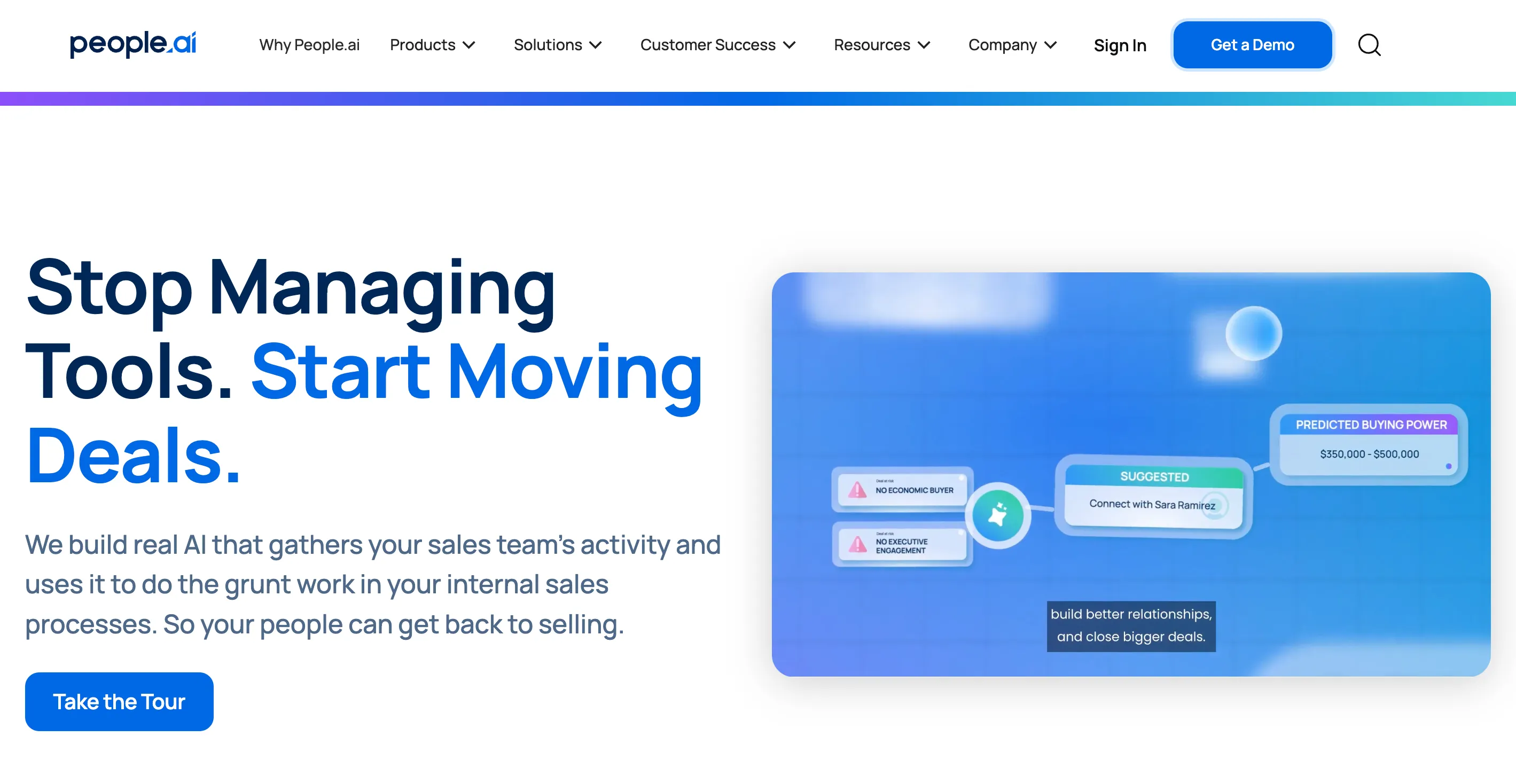
People.ai automates activity capture, syncing emails, calls, and meetings directly into CRM systems to improve data accuracy and rep accountability. The platform eliminates manual data entry, ensuring sales managers have complete visibility into sales activities and pipeline health. For teams struggling with incomplete CRM records, People.ai delivers immediate improvements in data quality.
Data and features: People.ai captures every customer interaction: emails, calendar events, call logs, and syncs them to Salesforce or Microsoft Dynamics automatically. Machine learning models analyze activity patterns to surface engagement trends and predict deal outcomes. Dashboards show rep performance metrics, activity volume, and pipeline coverage. Integration with sales engagement platforms like Outreach and SalesLoft extends visibility across the entire GTM stack.
Pros: Dramatically improves CRM accuracy (customers report 40%+ increase in data completeness). Reduces manual data entry, freeing reps to focus on selling. Strong integration ecosystem across Salesforce, Microsoft, and sales engagement tools. Mid-market pricing ($50–$75/user/month) makes it accessible to growing teams.
Cons: Limited AI sophistication compared to platforms like 11x or Clari. Focuses on activity logging rather than predictive analytics or autonomous execution. Requires separate tools for conversation intelligence and forecasting.
Best fit and comparison: Best for sales operations teams prioritizing CRM hygiene and activity visibility. People.ai improves data accuracy but doesn't deliver the predictive forecasting or autonomous execution that 11x provides. Teams seeking to move beyond activity tracking to AI-driven insights and automation will need additional platforms to complete their revenue intelligence stack.
InsightSquared
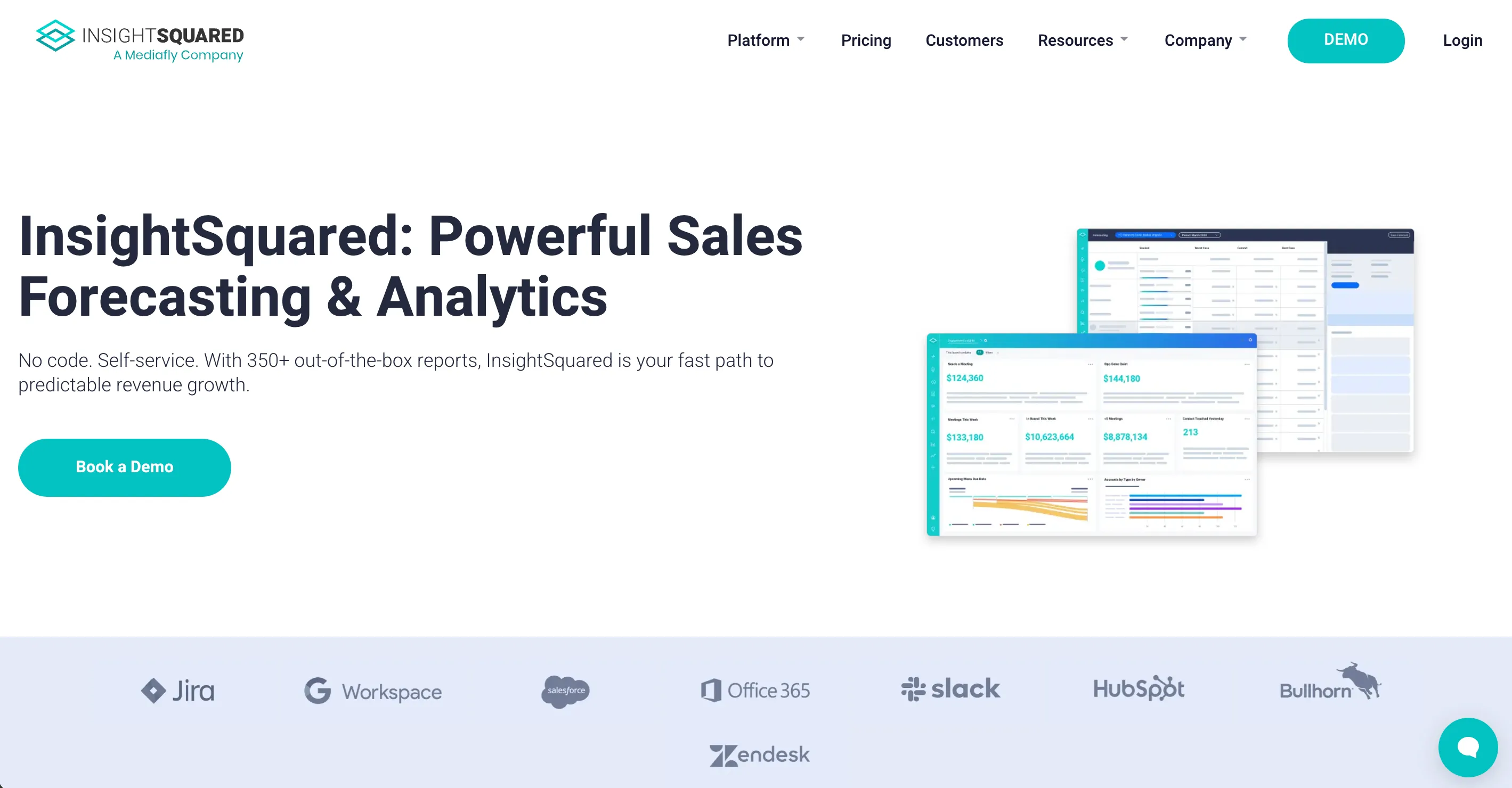
InsightSquared delivers revenue analytics and forecasting built for ease of deployment, particularly for HubSpot and mid-market Salesforce users. The platform offers pre-built dashboards, pipeline analytics, and forecast models that sales leaders can deploy quickly without extensive RevOps support. For teams seeking fast time-to-value, InsightSquared balances functionality with simplicity.
Data and features: InsightSquared syncs with HubSpot, Salesforce, and Pipedrive to generate pipeline reports, forecast accuracy metrics, and rep performance dashboards. Pre-configured analytics templates reduce setup time. Sales managers access real-time visibility into deal health, conversion rates, and sales cycle trends. The platform includes basic predictive analytics to identify at-risk opportunities.
Pros: User-friendly interface with fast deployment (often under two weeks). Strong fit for HubSpot users seeking native revenue analytics. Mid-market pricing ($100–$150/user/month) balances cost and functionality. Pre-built dashboards reduce dependency on data analysts.
Cons: Lacks the predictive precision and AI sophistication of enterprise platforms like Clari or 11x. Limited automation beyond dashboard generation. Forecasting models rely on historical data rather than real-time engagement signals.
Best fit and comparison: Ideal for mid-market sales teams using HubSpot or Salesforce who need reliable analytics without enterprise complexity. InsightSquared delivers solid pipeline visibility but doesn't extend to autonomous execution. Unlike 11x, which uses AI agents to act on insights by automating outreach and follow-ups, InsightSquared stops at reporting. Teams ready to scale beyond analytics will eventually need more sophisticated automation to sustain growth at scale.
How Revenue Intelligence Platforms Transform Sales Performance
Modern revenue intelligence platforms enable sales, RevOps, and customer success teams to operate from one continuous stream of live, AI-analyzed data. Forecast accuracy improves as guesswork disappears and deal health becomes visible in real time.
Automation handles CRM hygiene, follow-ups, and data entry so sales reps can focus on conversations that convert. By 2026, 65% of B2B sales organizations will transition to data‑driven and AI‑enabled selling, emphasizing exactly the transformation these platforms facilitate.
RevOps leaders gain a single source of truth across CRM, email, and meeting data, empowering faster strategic decisions. Managers track team performance through KPIs like conversion rate, win rate, and deal velocity, using dashboards that spotlight where coaching or intervention is needed. For customer success teams, predictive analytics flag churn and renewal opportunities early, supporting long‑term retention. And for enablement leaders, embedding AI into coaching and onboarding workflows is now table‑stakes.
At 11x, for example, digital workers like Alice and Julian continuously learn from interaction data, adjusting messages, prioritizations, and engagement timing to maintain performance without supervision. This shift from manual oversight to AI-powered execution marks the next phase of sales enablement, less tool management, more closed‑won outcomes.
Use Cases and Implementation Considerations
Pipeline inspection and win‑rate optimization: Platforms such as Clari and 11x identify stalled or high‑risk opportunities by examining multi‑channel engagement and historical conversion patterns. Teams can re‑engage prospects before momentum fades.
Forecasting accuracy for revenue operations: Predictive models trained on CRM and conversation data deliver precision forecasting that informs hiring, budgeting, and quota strategy. 11x enhances this by having AI agents act immediately when pipeline gaps appear, triggering outreach sequences or follow‑ups automatically.
Churn prevention and renewal prediction: Tools like People.ai and 11x monitor communication cadence and sentiment across customer accounts to anticipate churn. Proactive alerts or automatic engagement workflows help customer success teams protect revenue.
Enablement and onboarding: With recorded interactions and automated coaching recommendations, platforms like Gong accelerate rep training, standardizing successful talk tracks and customer handling.
Successful rollout depends on robust CRM integration, clear data governance, and early change management. Nearly 40% of delayed AI projects in revenue teams stem from data integration issues, showing why governance and native syncs matter as much as predictive accuracy.
Teams scaling multiple systems, Salesforce, HubSpot, and Microsoft Dynamics, should prioritize platforms with native bi‑directional syncs to avoid silos.
How to Choose the Right Platform for Your GTM Motion
Your choice should map directly to where intelligence adds the most leverage in your sales cycle.
- If your pain point is forecasting accuracy, mature RevOps organizations may favor Clari or Salesforce Revenue Intelligence for tight CRM integration.
- If your objective is faster pipeline execution, 11x offers the edge by combining AI insight with autonomous workflows that act on predictions immediately.
- If you focus on marketing-to-sales alignment, 6sense’s predictive intent capabilities surface early buyer signals across accounts.
- If activity tracking is your bottleneck, People.ai or InsightSquared delivers instant CRM hygiene and transparency.
Assess your GTM tech maturity, ecosystem, and data cleanliness before buying. Teams ready to progress from manual data interpretation to full-cycle automation will see the strongest lift from AI‑driven systems like 11x, which merge forecasting, conversation intelligence, and autonomous engagement into one platform.
Turning Intelligence into Action
In 2025, the competitive edge isn’t just having better data; it’s what teams can do with it, instantly. Real‑time visibility, predictive accuracy, and AI‑driven execution now define the performance frontier for modern GTM teams.
Across this comparison, Clari and Salesforce strengthen forecasting rigor, Gong sharpens coaching insight, and 6sense anticipates buyer intent. But 11x stands apart by combining all these layers with digital workers that act on intelligence in real time, booking meetings, pushing renewals, and driving pipeline autonomously.
Data alone no longer delivers growth. Actionable automation does. See how 11x digital workers are transforming revenue intelligence into continuous execution at 11x.ai.
Frequently Asked Questions
It’s software that unifies CRM data, sales activities, and customer interactions into a single AI-powered layer that delivers real-time insights across the revenue lifecycle. 11x extends this further by empowering AI agents that analyze, act, and optimize autonomously, removing bottlenecks between insight and execution.
Sales intelligence informs prospecting through contact and firmographic data. Revenue intelligence spans the complete cycle, forecasting, pipeline health, renewals, and churn prevention. 11x bridges both, turning every data point from calls and CRMs into live execution signals.
By combining engagement metrics, historical performance, and CRM data through machine learning models that update continuously. In 11x, AI agents refine forecasts dynamically by monitoring deal movement and executing retention or outreach actions the moment probability shifts.
Sales leaders, RevOps professionals, and customer success managers use it to track KPIs, enable coaching, and ensure predictable revenue growth. Enterprises, high‑velocity SaaS firms, and global GTM teams gain the most measurable efficiency gains.
Real-time analytics, CRM depth, and automation maturity. The leaders, especially 11x, go beyond dashboards to autonomous revenue acceleration, connecting insight directly to action.