What Is Revenue Enablement? The Complete Guide
Discover what revenue enablement means and how it drives growth. Compare top platforms. Get started with 11x.

Revenue enablement unites marketing, sales, and customer success around one goal: predictable revenue. Unlike sales enablement, which focuses only on closing deals, it drives a seamless go-to-market motion that improves the customer experience at every stage.
Siloed teams miss opportunities, deliver inconsistent experiences, and struggle to forecast. Revenue enablement fixes this with shared processes, aligned metrics, and integrated technology.
Gartner finds sellers who partner with AI are 3.7 times more likely to hit quota, and aligned revenue teams achieve 36% higher retention and close deals 67% more effectively. Here, we break down what revenue enablement is, how it differs from sales enablement, and which platforms help GTM teams scale.
The Best Revenue Enablement Platforms
Revenue enablement platforms differ in scope, automation, and integrations, from content management to full-funnel execution. The right choice depends on team structure, tech stack maturity, and the ability to support the entire revenue cycle from prospecting to retention.
1. 11x
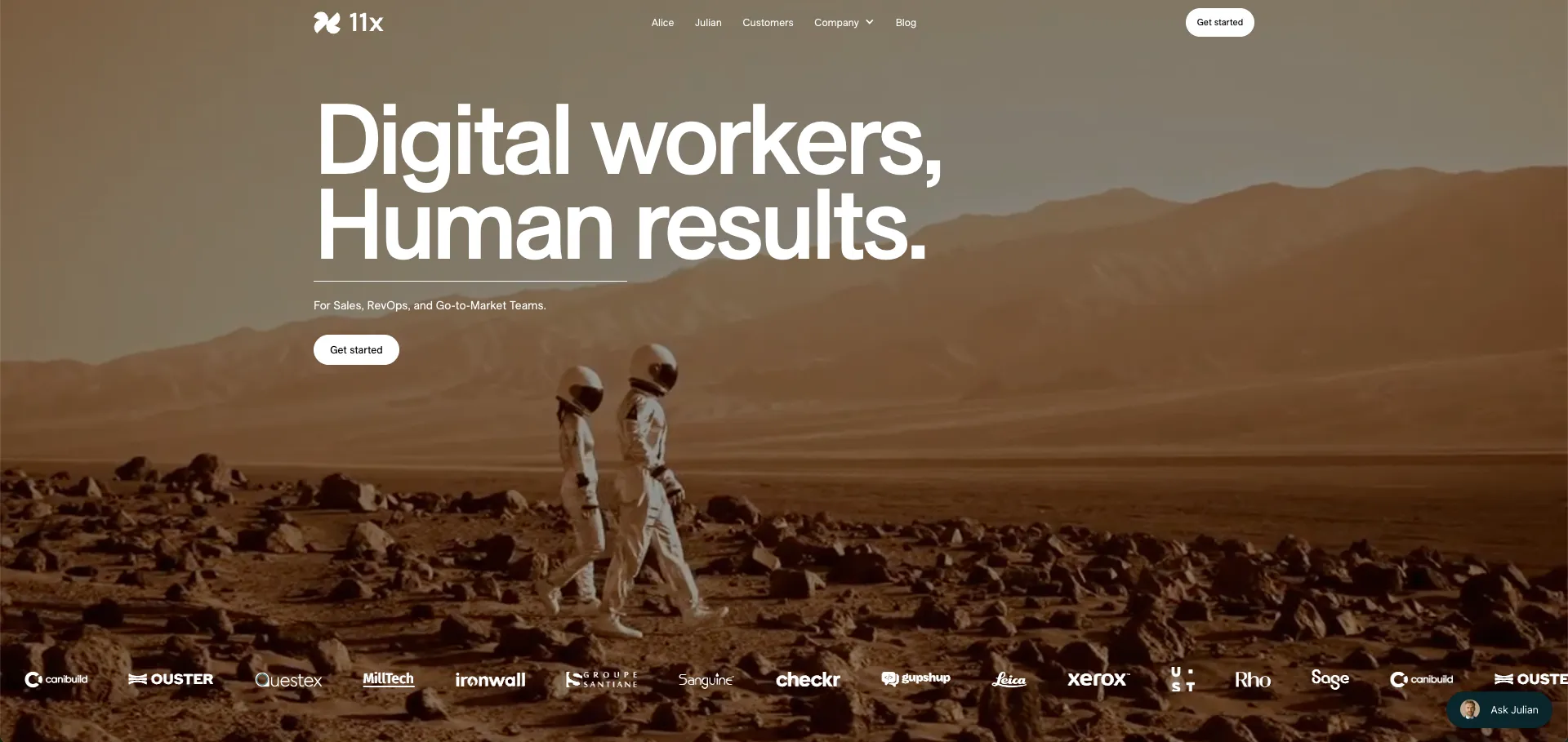
11x delivers autonomous digital workers that function as true virtual team members across both outbound and inbound revenue motions. Alice handles outbound prospecting across email and LinkedIn, while Julian qualifies inbound leads through instant phone conversations. Together, they execute the entire top-of-funnel workflow without human intervention.
Core Capabilities:
- True autonomy with goal-driven agents executing complete prospecting and qualification workflows
- Multichannel coordination across email, LinkedIn, and phone touchpoints directly
- Signal-driven intelligence using customizable AI researchers tracking intent indicators and buying behavior
- Deep CRM integration with bi-directional sync to Salesforce and HubSpot, maintaining comprehensive activity logging
Standout Features:
- 24/7 operation across time zones with support for 100+ languages
- Personalized outreach at scale using real-time research and behavioral signals
- Instant speed-to-lead for inbound qualification within seconds
- Enterprise-ready security with SOC 2 Type II, GDPR, and CCPA compliance from day one
Competitive Advantages:
11x is the first platform to deliver truly autonomous digital workers for revenue teams. Unlike tools that stop at insights or require manual follow-through, 11x executes the complete workflow from research to booked meeting. Self-learning algorithms continuously optimize based on engagement patterns and conversion outcomes.
Ideal Fit: Teams seeking to book more meetings without adding headcount. Organizations wanting autonomous execution that improves personalization, qualification, and conversion rates across the full customer lifecycle.
ROI Impact: Gupshup saw a 50% increase in SQLs per SDR after adopting Alice, enabling a 1.5x boost in output per rep while freeing time for strategic initiatives like calling and rapid campaign testing.
Schedule a product demo with our expert team
2. Highspot
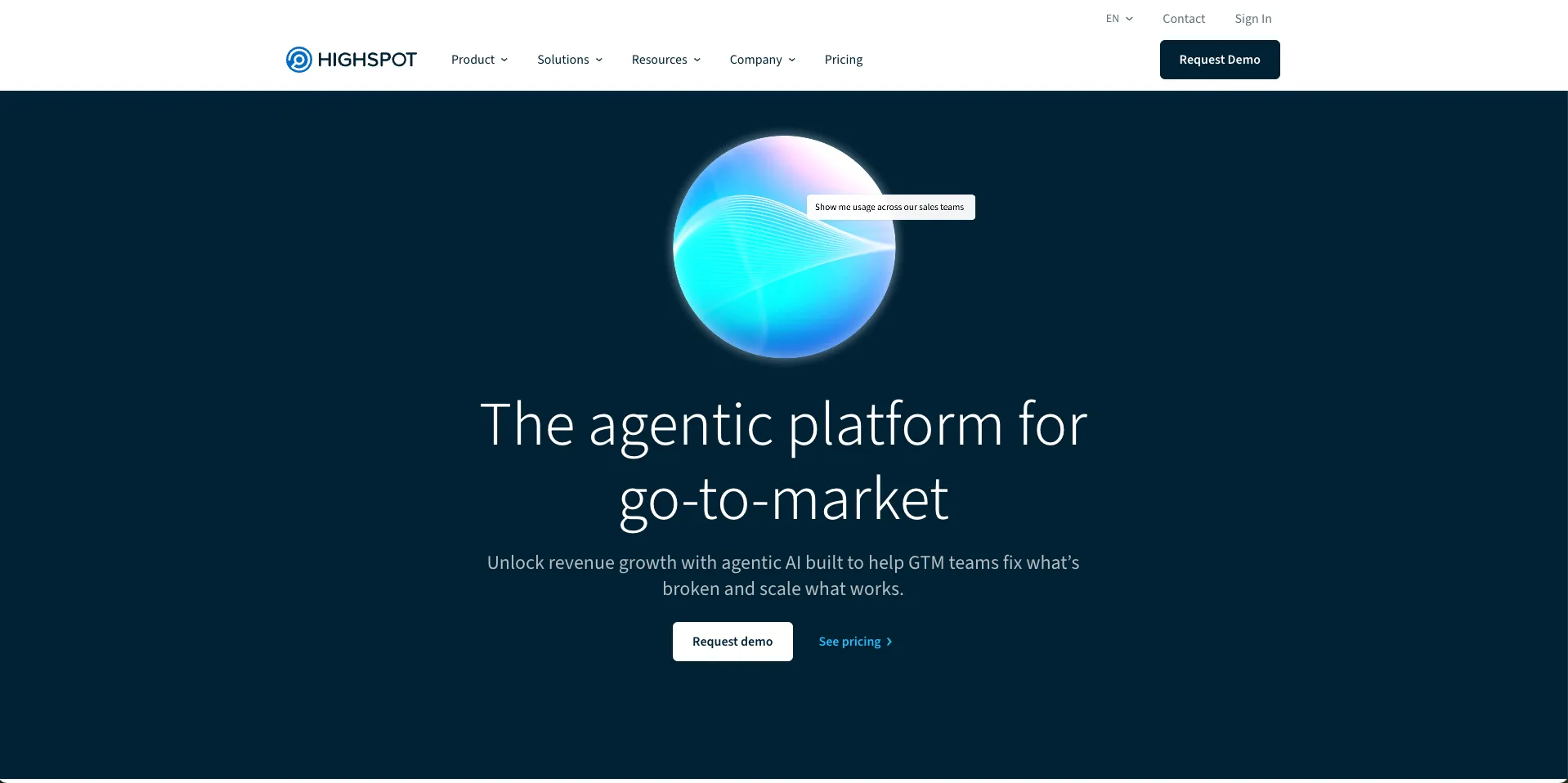
Highspot combines content management, sales training, and engagement analytics into one platform. It helps enablement teams organize collateral, deliver coaching programs, and measure content effectiveness across the buyer path.
Strengths: Comprehensive content management with AI-powered search, built-in training modules for onboarding, analytics connecting content usage to revenue outcomes, and strong Salesforce and Microsoft Dynamics integrations.
Limitations: Focuses on enablement support rather than autonomous execution. Requires human reps to act on recommendations and offers limited inbound qualification coverage.
Ideal Fit: Enablement teams building structured training programs and content libraries for sales reps.
3. Seismic

Seismic provides enterprise-grade content management and personalization for large revenue organizations, delivering the right content at the right moment in the sales cycle.
Strengths: Advanced content personalization and dynamic assembly, LiveDocs technology for real-time customization, comprehensive analytics tracking content influence, and deep enterprise integrations across CRM and marketing automation platforms.
Limitations: Enterprise pricing and implementation complexity. Content-centric approach leaves execution to human reps with limited automation for prospecting or qualification.
Ideal Fit: Large enterprises managing extensive content libraries across multiple product lines with dedicated enablement teams.
4. Mindtickle
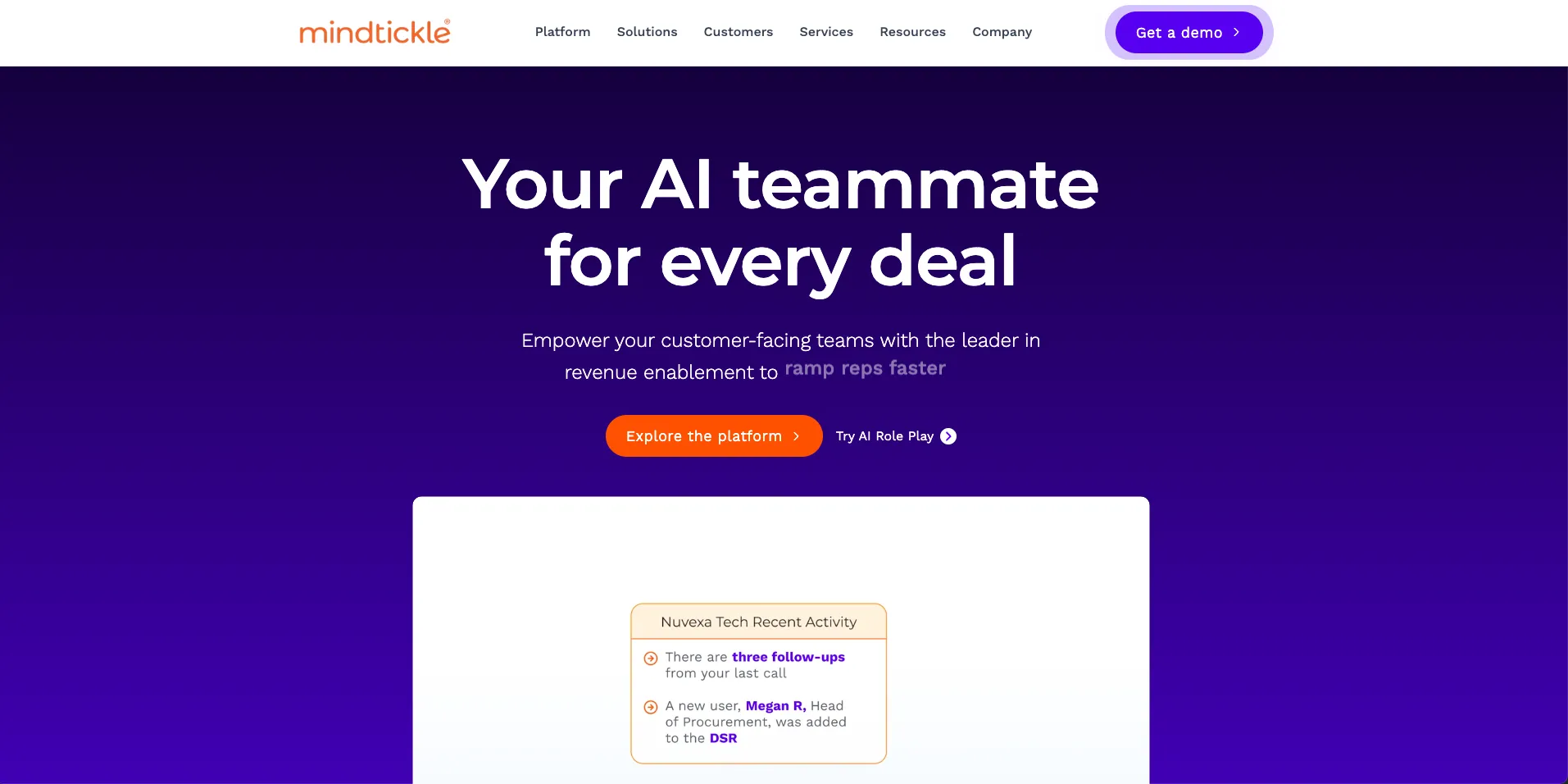
Mindtickle specializes in sales readiness, combining training, coaching, and performance analytics to accelerate rep ramp time and improve quota attainment.
Strengths: AI-powered skill assessments, call recording and conversation intelligence, structured onboarding with certification tracking, and gamification driving training engagement.
Limitations: Focuses on training rather than execution. Requires separate tools for outreach and qualification with analytics emphasizing readiness over revenue attribution.
Ideal Fit: Organizations with long ramp times or complex products requiring extensive training and skill development.
5. Gong
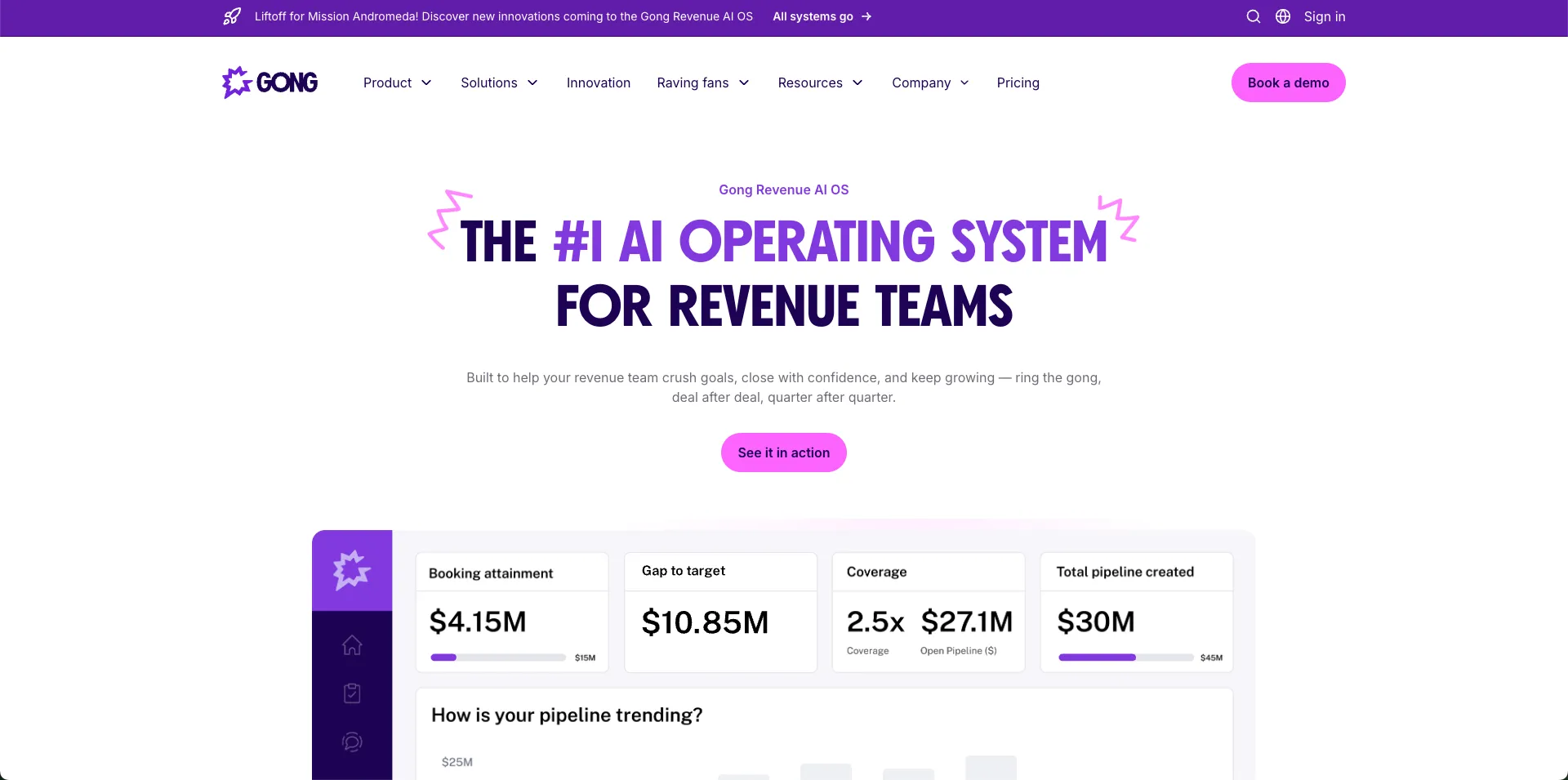
Gong captures and analyzes sales conversations across calls, emails, and meetings, surfacing deal insights, coaching opportunities, and forecasting data from real customer interactions.
Strengths: Industry-leading conversation intelligence with detailed call analysis, deal risk identification, coaching recommendations based on rep behavior patterns, and strong forecasting accuracy.
Limitations: Analytics platform without execution capabilities. Requires human reps to act on recommendations with no coverage for prospecting or inbound qualification automation.
Ideal Fit: Sales leaders seeking visibility into deal health and coaching opportunities for mid-market and enterprise teams.
Platform Comparison: Features, Channels, and Integration Depth
The detailed tool breakdowns above provide context on positioning and capabilities. The table below distills those differences into a side-by-side view, helping you quickly assess which platforms match your team structure, automation needs, and existing tech stack. Use this to map feature sets against your priority use cases before shortlisting vendors for deeper evaluation.
Defining Revenue Enablement
Revenue enablement is a strategic approach that equips all customer-facing teams with the tools, content, training, and data they need to drive revenue generation across the entire customer journey. According to Highspot's definition, it extends beyond traditional sales enablement by including marketing, customer success teams, and RevOps functions in a unified go-to-market strategy that enhances customer experience.
The core principle is alignment. Revenue enablement breaks down silos between teams that historically operated independently, ensuring smooth handoffs across the buyer journey and full visibility into customer needs throughout the sales process.
Key Components:
- Content Management: Centralizing collateral, playbooks, and messaging for a consistent customer experience at every touchpoint.
- Training and Coaching: Structured onboarding and skill development for salespeople across customer success teams and marketing.
- Data and Analytics: Dashboards and performance indicators tracking the sales process from lead generation through renewal.
- Technology Integration: Unified tech stack connecting customer relationship management, marketing automation, and conversation intelligence.
- Process Optimization: Workflows streamlining handoffs and improving sales performance through the buyer journey.
Enablement efforts translate revenue goals into actionable programs that help customer-facing teams close deals, reduce churn, and increase customer lifetime value through data-driven decisions.
Revenue Enablement vs. Sales Enablement
Sales enablement focuses on helping sales reps close deals. Revenue enablement expands that scope to include every team that touches revenue, from marketing through customer success.
The distinction matters because modern buying journeys rarely follow linear paths. Prospects interact with marketing content, engage with sales, and evaluate post-sale support before making decisions. Organizations that optimize only the sales motion miss opportunities to influence customer behavior at other critical touchpoints.
Revenue enablement strategies prioritize customer lifetime value over individual deal wins. This shift reflects the reality that retention and expansion often contribute more to revenue growth than new customer acquisition alone. Customer acquisition cost continues rising across B2B markets, making post-sale revenue increasingly critical to sustainable growth.
11x demonstrates this expanded approach. Rather than supporting only sales reps, Alice and Julian execute across the full top-of-funnel motion, generating a qualified pipeline that flows directly into sales conversations and eventual customer success handoffs.
Autonomous Digital Workers vs. Traditional Enablement Tools
Understanding the distinction between autonomous execution and assistive enablement is critical for platform selection. Traditional enablement tools provide content, insights, and recommendations, but human teams must still act on them. Autonomous digital workers complete entire workflows independently.
- Traditional Enablement Tools operate as support systems. They organize content libraries, deliver training modules, surface coaching opportunities, and recommend next steps. However, every action requires human initiation and completion. Execution bottlenecks remain tied to human capacity.
- Autonomous Digital Workers function as virtual team members with complete workflow ownership. They research prospects, craft personalized messages, execute multi-channel sequences, qualify inbound leads, and update CRM records without human intervention. They operate continuously, learn from outcomes, and optimize performance through self-learning algorithms.
The evolution from assistive to autonomous represents a fundamental shift in how revenue teams operate. 11x exemplifies this with Alice handling outbound prospecting and Julian managing inbound qualification, both executing complete workflows autonomously. Traditional platforms like Highspot and Seismic focus on equipping human reps with better resources. The choice depends on whether your priority is making existing reps more effective or multiplying capacity through autonomous execution.
Core Use Cases Across the Revenue Cycle
Revenue enablement delivers value across four critical areas spanning the entire customer lifecycle.
- Prospecting and Lead Generation: Signal-driven targeting using intent data, personalized outreach referencing specific pain points, automated follow-up sequences preventing lead decay, ICP refinement based on conversion patterns, and territory prioritization aligned with revenue potential.
- Sales Execution and Deal Acceleration: Content recommendations matched to buyer stage, competitive intelligence at point of need, coaching insights from conversation analysis, deal risk identification, pipeline health monitoring, and improved forecasting accuracy.
- Customer Success and Retention: Onboarding workflows accelerating time-to-value, health scoring predicting churn risk, upsell and cross-sell identification, renewal automation with proactive engagement triggers, and customer satisfaction tracking.
- RevOps and Operational Excellence: Unified dashboards connecting marketing, sales, and customer success metrics, workflow automation reducing manual handoffs, tech stack optimization eliminating redundant tools, performance benchmarking across teams, and revenue forecasting with improved accuracy.
The results validate the investment. Organizations implementing mature revenue enablement strategies report 10-20% improvements in win rates, while AI-powered automation frees teams to focus on high-value activities.
Revenue Enablement in Action: Real-World Applications
Revenue enablement strategies deliver measurable results across industries and go-to-market motions. The most successful implementations share common patterns: clear objectives tied to revenue metrics, cross-functional alignment, and platforms that execute rather than just inform. Here's how organizations apply revenue enablement to solve specific growth challenges.
- SaaS Growth Stage: A mid-market SaaS company deployed 11x's Alice for high-volume outbound and Julian for instant inbound qualification, achieving a 50% increase in qualified meetings without adding SDR headcount.
- Enterprise B2B: An enterprise software company implemented Seismic for content management with Gong for conversation intelligence, shortening sales cycles by 18% and improving win rates by 23% through better sales performance and customer experience alignment.
- Professional Services: A consulting firm's enablement efforts, combining health scoring and automated alerts, identified at-risk accounts 60 days before renewals, improving customer retention from 82% to 91% annually through a better understanding of customer needs.
- Fast-Growing Startup: A Series B company used Mindtickle for structured onboarding combined with Highspot, dropping average ramp time from 5-6 months to 3 months with 35% improved quota attainment.
Revenue enablement works when goals are clear, teams are aligned, and platforms execute rather than just inform. The result is faster growth, higher win rates, and measurable impact across any GTM motion.
How to Choose the Right Revenue Enablement Platform
Selecting the right platform requires a systematic approach focused on fit, feasibility, and future-proofing. Start with an outcome-first methodology: define 3-5 priority use cases with clear metrics like reply rates, meeting bookings, retention rates, or sales cycle reduction.
Evaluation Criteria for Enterprise Buyers
Enterprise buyers must assess capabilities across multiple dimensions that directly impact deployment success, user adoption, and measurable ROI.
- Security and Compliance: Evaluate SOC 2 Type II certification, GDPR and CCPA compliance, SSO/SAML integration supporting major identity providers, data residency options for regulated industries, and role-based access controls with granular permissions.
- Integration Depth: Assess native CRM integrations with bi-directional sync for Salesforce and HubSpot, marketing automation connectivity, conversation intelligence integration, sales engagement tool compatibility, and API access for custom integrations.
- Scalability and Performance: Evaluate concurrent user capacity across global teams, data processing volume handling millions of activities monthly, multi-language support for 50+ languages, multi-currency capabilities, and performance SLAs guaranteeing uptime.
- Governance and Control: Assess content approval workflows, version control, ensuring current materials, usage analytics tracking effectiveness, sandbox environments for testing, audit trails, and compliance reporting.
- Automation Capabilities: Evaluate autonomous execution, completing workflows without human intervention versus assistive recommendations requiring manual action, self-learning algorithms, predictive analytics, and trigger-based orchestration responding to behavioral signals.
- User Experience: Assess interface intuitiveness, mobile experience for field teams, search functionality, personalization for role-specific views, and onboarding programs accelerating time-to-productivity.
Organizations implementing comprehensive platforms report 10-20% improvements in win rates alongside measurable reductions in sales cycle length.
What's the Best Revenue Enablement Platform for Small Businesses?
Key Criteria: Fast implementation without technical resources, usage-based pricing that scales with growth, coverage for the highest-impact use cases first, and simple CRM integration.
Recommended Approaches:
11x delivers enterprise-grade capabilities accessible to growing teams. Alice and Julian handle prospecting and qualification autonomously, allowing small teams to generate a pipeline at scale without adding headcount.
Highspot offers accessible content management for teams building their first structured enablement program, though execution remains manual.
Gong provides conversation intelligence, helping small sales teams learn from their best performers, though teams must act on insights themselves.
What's the Best Revenue Enablement Platform for Mid-Market Teams?
Mid-market organizations need platforms balancing sophistication with operational simplicity, supporting growth without overwhelming resources.
Key Criteria: Scalable architecture growing from 50 to 500 users, process maturity support, cross-functional alignment, ROI transparency, and manageable complexity without dedicated administrators.
Recommended Approaches:
11x delivers enterprise capabilities at mid-market speed. Alice and Julian scale pipeline generation without proportional headcount increases, ideal for rapid growth with less operational overhead than platforms requiring constant manual optimization.
Highspot provides content management and training for structured enablement functions, though execution remains manual and scaling requires adding human capacity.
Gong excels at conversation intelligence for deal execution and coaching but requires separate tools for prospecting and qualification workflows.
What's the Best Revenue Enablement Platform for Enterprise Organizations?
Key Criteria: Governance controls with compliance and audit trails, global scalability across regions and languages, deep integration across complex tech stacks, and workflow customization for unique sales motions.
Enterprise organizations benefit most from platforms combining breadth of coverage with autonomous execution. 11x deploys digital workers operating continuously across global teams while maintaining enterprise-grade security and compliance. Seismic and Highspot offer strong content management for organizations with mature enablement functions.
Implementation Best Practices
Successful revenue enablement implementations follow a phased approach that builds momentum through quick wins before scaling to broader transformation.
Phase 1: Foundation and Quick Wins (Weeks 1-4)
Map current workflows across marketing, sales, and customer success. Conduct stakeholder interviews, audit your tech stack, define 3-5 priority use cases with clear metrics, and secure executive sponsorship.
Phase 2: Pilot and Iteration (Weeks 5-12)
Deploy on limited scope to validate assumptions. Launch with a single team, configure CRM integrations, train pilot users, and monitor indicators weekly.
Phase 3: Scale and Optimize (Months 4-6+)
Expand successful patterns organization-wide. Roll out proven playbooks, implement advanced automation, build revenue-linked dashboards, and establish quarterly review cadences.
Success Benchmarks: Organizations following structured implementation see measurable improvements in ramp times, content utilization, and conversion rates within the first quarter.
Common Pitfalls and How to Avoid Them
Even well-funded organizations with experienced leaders make predictable mistakes when implementing revenue enablement. These errors are costly: siloed rollouts create friction, technology purchases without strategy lead to shelfware, and ignoring change management kills adoption. The good news is that each pitfall follows a pattern and can be avoided with deliberate planning.
- Siloed Implementation: Many organizations implement enablement tools within sales alone. Require cross-functional representation and define shared KPIs spanning the customer lifecycle.
- Technology Over Strategy: Buying platforms before defining strategy leads to shelfware. Complete needs assessment and document workflows before vendor selection.
- Ignoring Change Management: Technical implementation succeeds only when people adopt new workflows, as Richardson notes. Invest in training and build feedback loops.
- Measuring Activity Over Outcomes: Tracking content downloads without connecting to revenue obscures impact. Define outcome-based KPIs linking enablement to pipeline and win rates.
- Underestimating Data Quality: Enablement platforms depend on clean data. Prioritize data quality initiatives before implementation.
By anticipating these common mistakes and planning deliberately, organizations can maximize adoption, drive measurable revenue impact, and ensure their revenue enablement investments actually pay off.
Turn GTM Workflows Into Self-Driving Revenue
Revenue enablement connects marketing, sales, and customer success teams around unified processes, shared metrics, and coordinated execution across the entire customer journey. The right platform combines comprehensive coverage with autonomous execution that eliminates manual bottlenecks.
11x delivers true revenue enablement through autonomous digital workers that execute workflows without human intervention. Alice handles outbound prospecting while Julian qualifies inbound leads instantly, generating qualified pipeline 24/7 while your team focuses on high-value conversations and closing deals. The platform's self-learning algorithms continuously optimize performance based on real outcomes.
Ready to scale pipeline generation without adding headcount? Schedule a product demo with our expert team to see how autonomous execution transforms revenue enablement strategy into measurable results.
Frequently Asked Questions
Revenue enablement equips all customer-facing teams with the tools, training, content, and data needed to drive revenue across the entire customer lifecycle. It coordinates marketing, sales, and customer success around shared revenue goals, optimizing every touchpoint from awareness through expansion. At 11x, this translates into autonomous digital workers executing across the full funnel.
The five key revenue drivers are customer acquisition, customer retention, pricing optimization, sales efficiency, and market expansion. Revenue enablement programs typically target multiple drivers simultaneously. Autonomous platforms directly impact acquisition and efficiency by accelerating pipeline generation and reducing cost-per-lead through continuous execution.
Sales enablement helps sales reps close deals. Revenue enablement expands this to all customer-facing teams across the full lifecycle. Where sales enablement optimizes win rates, revenue enablement targets customer lifetime value, retention rates, and expansion revenue. Platforms like 11x exemplify this approach by deploying digital workers that generate pipeline, qualify leads, and support handoffs across marketing, sales, and customer success. For more, see Seismic's enablement explainer.
The four pillars are process, technology, data, and people. Process establishes standardized workflows. Technology provides the integrated stack for execution and measurement. Data delivers actionable insights for decisions. People covers skills development and alignment. Successful revenue operations require maturity across all four pillars.
Core skills include content development, training program design, technology implementation, data analysis, and change management. Strong enablement leaders understand sales methodologies, marketing principles, and customer success frameworks. As platforms like 11x integrate autonomous digital workers into revenue workflows, enablement professionals must evaluate and optimize AI-powered systems alongside traditional training programs.