B2B Marketing Automation Strategy: 7 Best Platforms for 2026
Build your B2B marketing automation strategy with the top platforms for 2026. Get started with 11x.

Manual marketing processes drain productivity and let qualified prospects slip through the cracks. Your marketing team sends emails. Your sales team chases leads. Customer experience suffers. And somewhere between the two, the buying process breaks down. A solid B2B marketing automation strategy solves this by connecting every touchpoint, from first click to closed deal.
The business case is clear: B2B companies with mature automation strategies consistently outperform those relying on manual processes, achieving faster sales cycles and higher lead-to-customer conversion rates. Marketing automation frees teams from repetitive tasks while ensuring consistent follow-up across the sales funnel.
This guide delivers a criteria-driven comparison of the best B2B marketing automation platforms for 2026. Our methodology prioritizes neutral, feature-based analysis: 90% objective capability comparisons, 10% strategic insights from GTM experience. You'll discover which tools excel at lead nurturing, segmentation, multi-channel outreach, and CRM integration, plus how to build automation workflows that convert.
What Is a B2B Marketing Automation Strategy?
A B2B marketing automation strategy uses technology to execute repetitive marketing tasks, nurture leads, and deliver personalized experiences. Unlike manual processes, automation executes email campaigns, lead scoring, segmentation, and follow-up sequences based on real-time engagement data.
Key components include lead scoring (ranking by demographics, company size, and behavior), segmentation (grouping by industry, pain points, and buyer personas), email marketing, lead nurturing, and CRM integration. Advanced platforms incorporate AI-powered capabilities that learn from conversion data to optimize messaging and timing.
How B2B Marketing Automation Transforms Traditional Processes
Traditional marketing relied on manual list building, batch email sends, and disconnected follow-up. B2B marketing automation shifts this to proactive engagement, identifying buying intent and initiating outreach before competitors act.
The impact is measurable: organizations implementing marketing automation report 14.5% increases in sales productivity. Contentstack analysis shows mature automation strategies achieve faster sales cycles and improved conversion rates.
Autonomous Digital Workers vs. Rule-Based Automation
This distinction matters for platform selection.
Rule-based automation executes predefined workflows when triggers fire. If a prospect downloads content, send email A. If they visit pricing, notify sales. These systems require manual configuration for every scenario.
Autonomous digital workers operate as goal-driven agents owning complete outcomes. They research prospects, craft personalized messages, execute multi-channel outreach, and qualify leads independently. 11x pioneered this approach with Alice and Julian.
The following comparison shows the key differences between approaches.
The evolution isn't replacement but augmentation. Autonomous systems handle volume and repetitive execution. Human marketers focus on strategy, creative, relationship building, and improving customer experience across every touchpoint.
The Best B2B Marketing Automation Platforms
Our analysis covers leading platforms across lead generation, email marketing, account-based marketing, and AI-powered execution.
Evaluation Criteria
Our methodology prioritizes neutral, criteria-driven analysis: 90% objective feature comparisons, 10% strategic insights from GTM experience. Selection criteria include customer lifecycle coverage, AI sophistication, multi-channel capabilities, CRM integration quality, governance features, and proven outcomes.
1. 11x
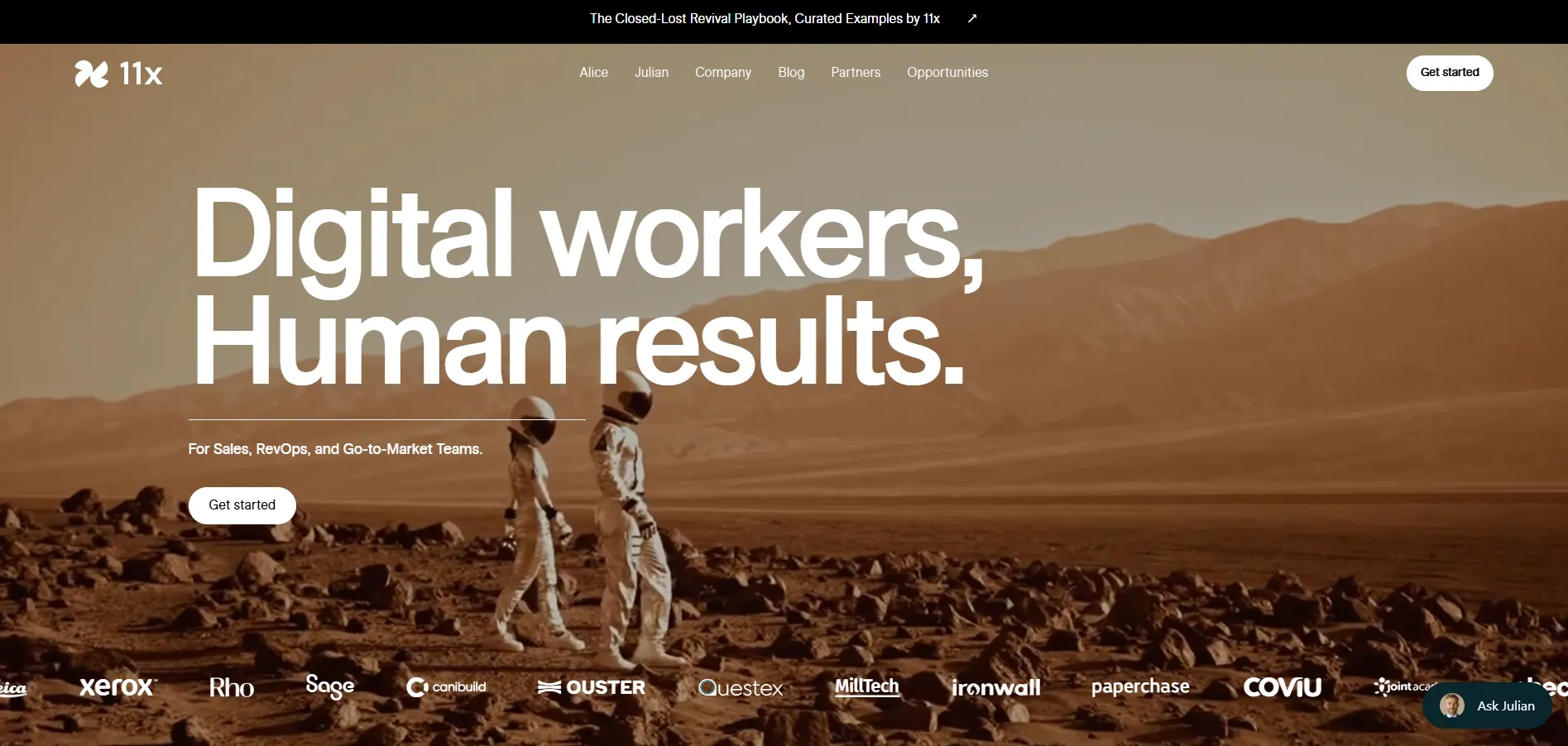
11x deploys autonomous digital workers that operate as virtual team members for your GTM motion. Unlike traditional marketing automation platforms requiring manual workflow configuration, 11x agents own sales outcomes across the complete buyer lifecycle. The platform includes two AI agents: Alice, the AI GTM agent handling outbound prospecting across email and LinkedIn, and Julian, the AI inbound sales rep managing qualification through natural two-way conversations.
11x Key Features:
- Alice (AI GTM Agent): Conducts outbound prospecting across email and LinkedIn to secure qualified meetings with personalized messaging
- Julian (AI Phone Agent): Calls inbound leads within seconds and qualifies them through natural two-way conversations
- Autonomous Operation: Goal-driven agents execute complete automation workflows independently without manual triggers or continuous configuration
- CRM Integration: Bi-directional sync with Salesforce and HubSpot maintains clean activity logs and forecasting data
- Enterprise Security: SOC 2 Type II, GDPR, and CCPA compliance built in from day one
Pros and Cons of 11x
11x Best Fit: B2B companies seeking to book more meetings without adding headcount. Organizations wanting autonomous execution, personalized experiences, and conversion improvements across funnel stages. Compared to rule-based platforms, 11x autonomously identifies, engages, and qualifies leads across outbound and inbound workflows.
ROI Impact: Gupshup saw a 50% increase in SQLs per SDR after adopting Alice, enabling a 1.5x boost in output per rep and freeing time for strategic initiatives.
11x Pricing: Custom enterprise plans with usage-based tiers tied to lead volume and integration scope.
2. HubSpot Marketing Hub
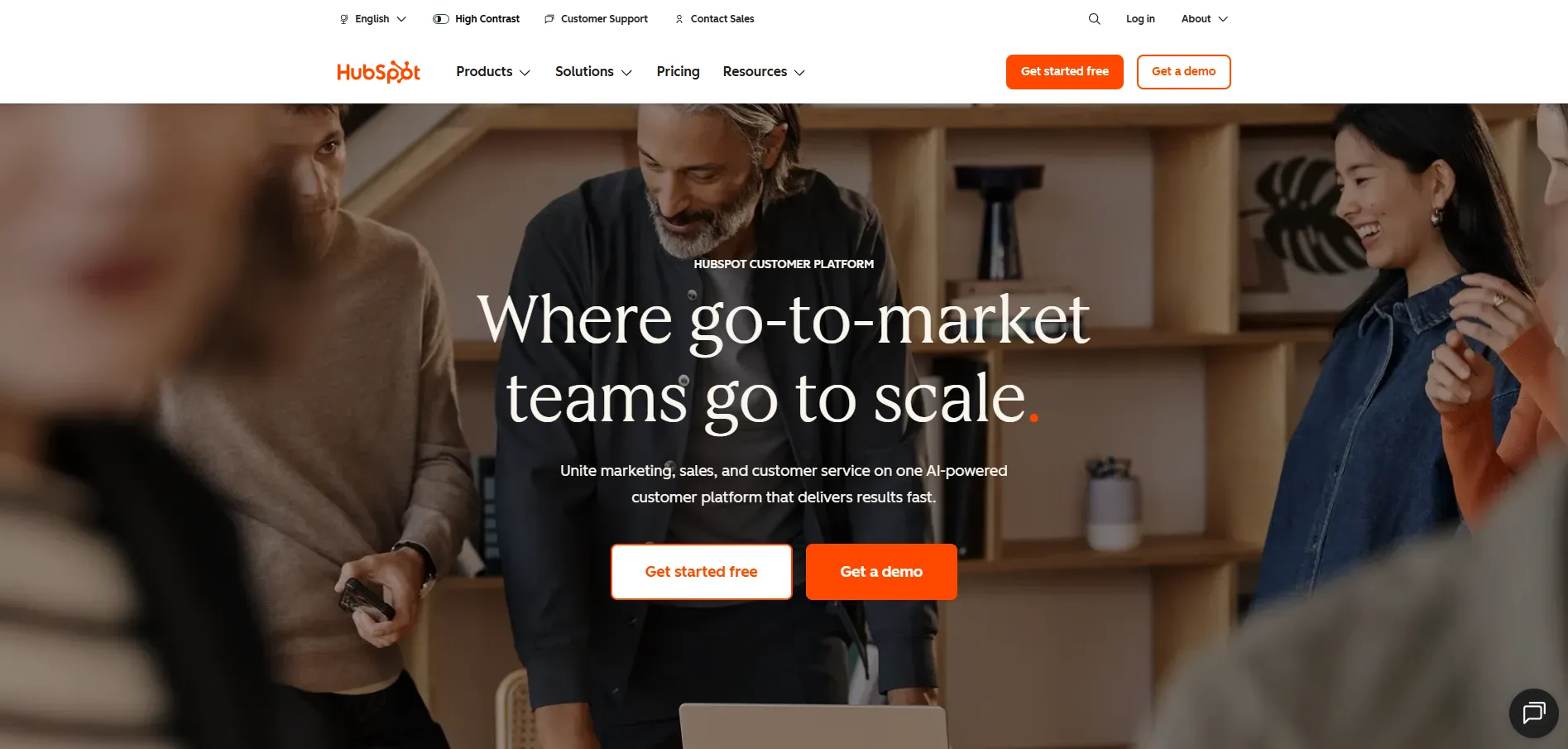
HubSpot combines marketing automation software with its native CRM, creating unified workflows connecting marketing and sales teams through shared customer data. The platform excels at bringing email marketing, landing pages, social media management, and analytics into a single ecosystem accessible to teams without technical resources.
HubSpot Key Features:
- Native CRM Integration: Eliminates data silos between marketing and sales, providing complete visibility into the customer journey from first touch to closed deal
- Visual Workflow Builder: Enables non-technical marketers to create sophisticated automation sequences with drag-and-drop simplicity
- Lead Scoring: Prioritizes follow-up for sales teams based on engagement patterns, demographics, and behavioral signals
- Integration Ecosystem: Connects with social media platforms, advertising networks, and third-party tools
- Free Tier: Provides genuine value for small business teams starting their automation journey
Pros and Cons of HubSpot
HubSpot Best Fit: B2B marketers needing unified CRM and marketing automation without dedicated technical resources. Teams wanting comprehensive functionality in a single platform rather than stitching together point solutions.
HubSpot Pricing: Free tier available; Starter from $9/month; Professional from $800/month; Enterprise from $3,600/month.
3. Salesforce Marketing Cloud
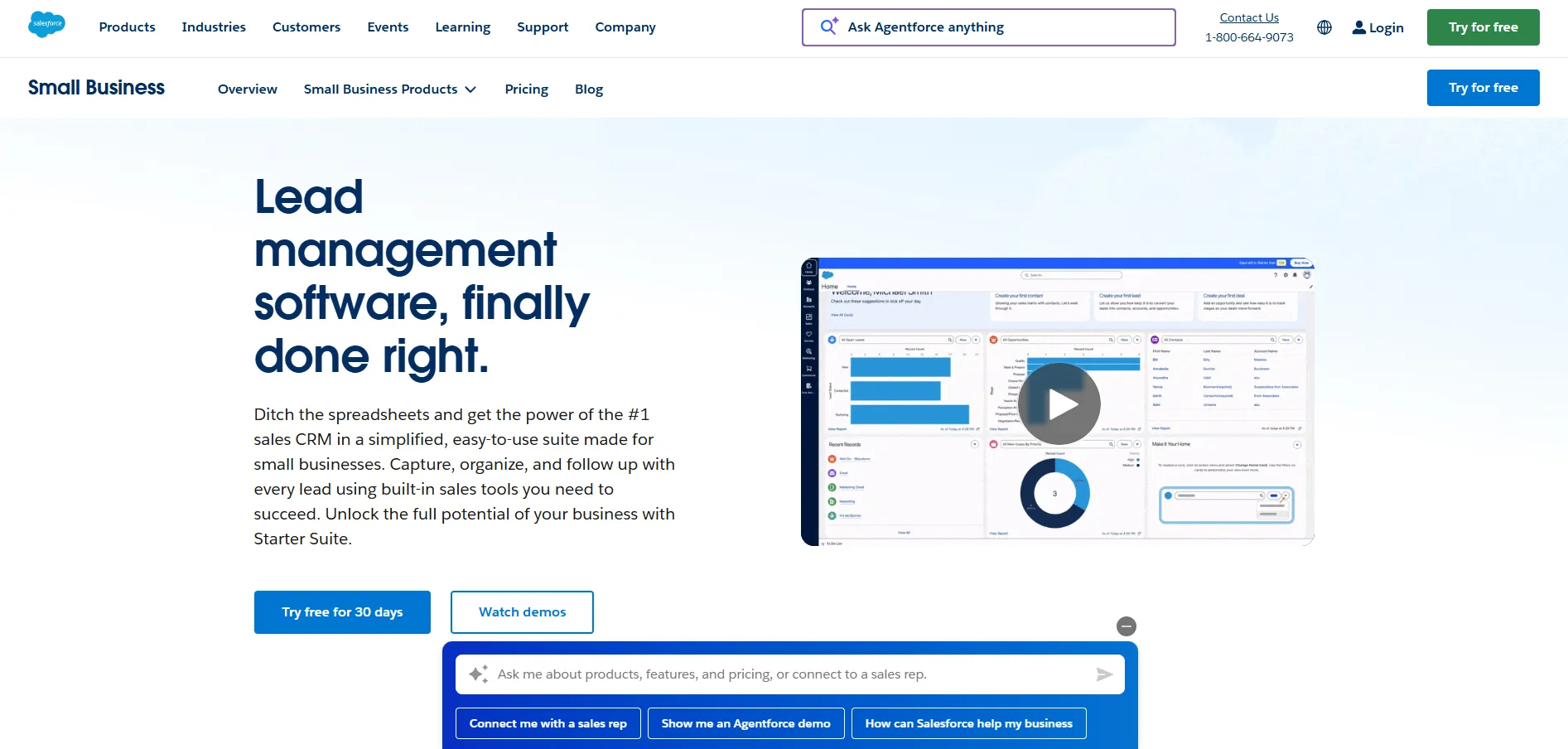
Salesforce Marketing Cloud delivers enterprise-grade marketing automation integrated with the broader Salesforce ecosystem. Marketing Cloud CDP enables unified customer profiles across touchpoints, while Einstein AI and emerging Salesforce agentic marketing capabilities support complex B2B marketing automation strategies across global organizations. The platform also connects with Agentforce Marketing Cloud for AI-driven campaign orchestration.
Salesforce Marketing Cloud Key Features:
- Deep CRM Integration: Provides unified customer profiles and seamless data flow between marketing and sales
- Attribution Modeling: Connects marketing campaigns directly to revenue outcomes and pipeline metrics
- Einstein AI: Optimizes send times, recommends content, and predicts engagement patterns based on historical data
- Marketing Cloud Core: Supports account-based marketing for targeting entire buying committees
- Analytics Dashboards: Delivers valuable insights for data-driven optimization
Pros and Cons of Salesforce Marketing Cloud
Salesforce Marketing Cloud Best Fit: Large B2B companies already invested in the Salesforce ecosystem seeking advanced analytics, ABM orchestration, and enterprise-grade compliance. Organizations with dedicated marketing operations teams.
Salesforce Marketing Cloud Pricing: Custom enterprise pricing based on features and volume; typically $1,500-$15,000+/month depending on modules.
4. Marketo Engage (Adobe)
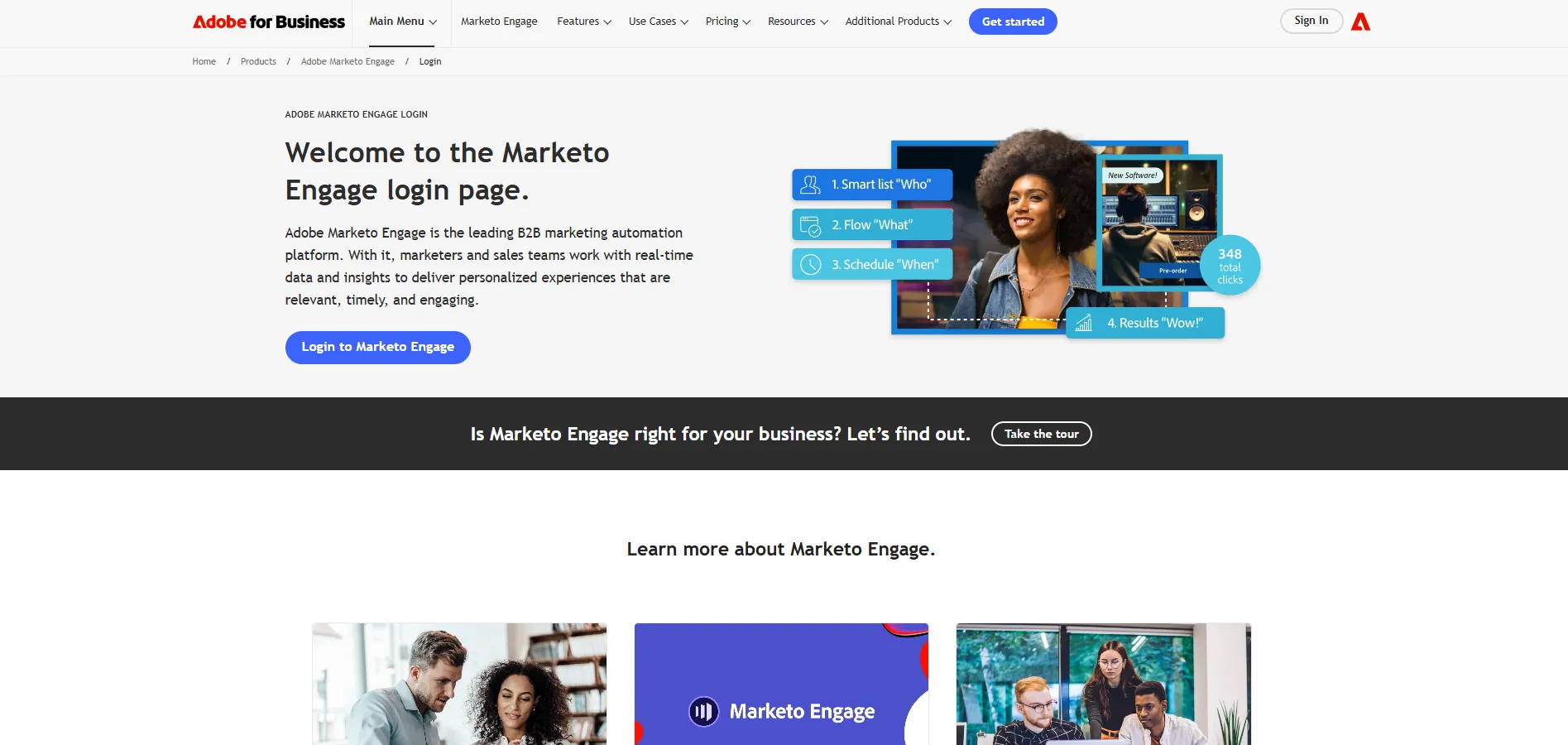
Adobe Marketo Engage provides sophisticated lead nurturing and scoring designed for complex B2B sales cycles with multiple decision-makers. The platform supports detailed buyer persona development with behavioral triggers and revenue cycle analytics connecting marketing efforts directly to pipeline outcomes.
Marketo Engage Key Features:
- Advanced Lead Scoring: Incorporates behavior, demographics, engagement velocity, and account-level signals for precise qualification
- Nurture Tracks: Supports complex buyer journeys based on personas, stages, and engagement patterns
- Webinar Integrations: Streamlines event marketing with automated registration, reminders, and follow-up sequences
- Revenue Cycle Analytics: Connects marketing touches to closed revenue, enabling accurate attribution across long sales cycles
- Segmentation Capabilities: Supports highly targeted messaging to specific audience segments
Pros and Cons of Marketo Engage
Marketo Engage Best Fit: B2B companies with dedicated marketing operations teams running complex multi-touch nurture programs across long sales cycles. Organizations needing sophisticated scoring and attribution.
Marketo Engage Pricing: Custom pricing depending on the user’s needs.
5. Brevo
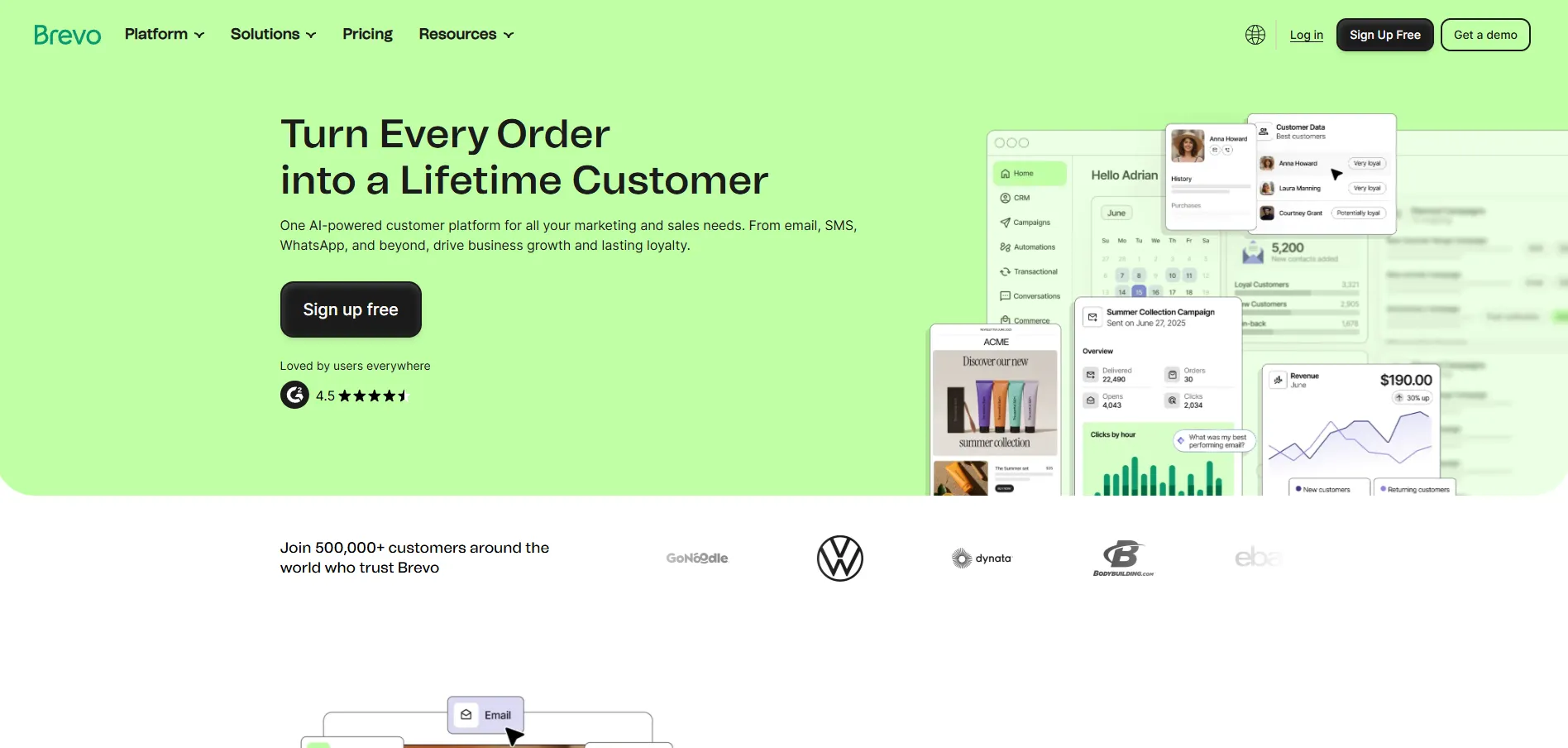
Brevo (formerly Sendinblue) delivers budget-friendly B2B marketing automation with strong multi-channel capabilities spanning email, SMS, chat, and WhatsApp. The platform combines visual workflow builders with straightforward pricing based on email volume rather than contact count, making it accessible for growing B2B companies managing large databases.
Brevo Key Features:
- Multi-Channel Automation: Coordinates campaigns across email marketing, SMS, WhatsApp, and live chat from a single platform
- Visual Workflow Builder: Drag-and-drop automation sequences with conditional logic and branching paths for lead nurturing
- Transactional Email: Reliable delivery infrastructure for order confirmations, password resets, and triggered notifications
- CRM Integration: Built-in CRM with contact management, deal tracking, and pipeline visibility for sales teams
- Landing Pages: Create conversion-optimized pages for lead generation campaigns without external tools
Pros and Cons of Brevo
Brevo Best Fit: Budget-conscious B2B companies needing multi-channel marketing automation without enterprise complexity. Teams wanting email, SMS, and chat coordination at accessible price points with straightforward workflow builders.
Brevo Pricing: Business plans from $9/month; Enterprise with custom pricing based on volume and features.
6. ActiveCampaign
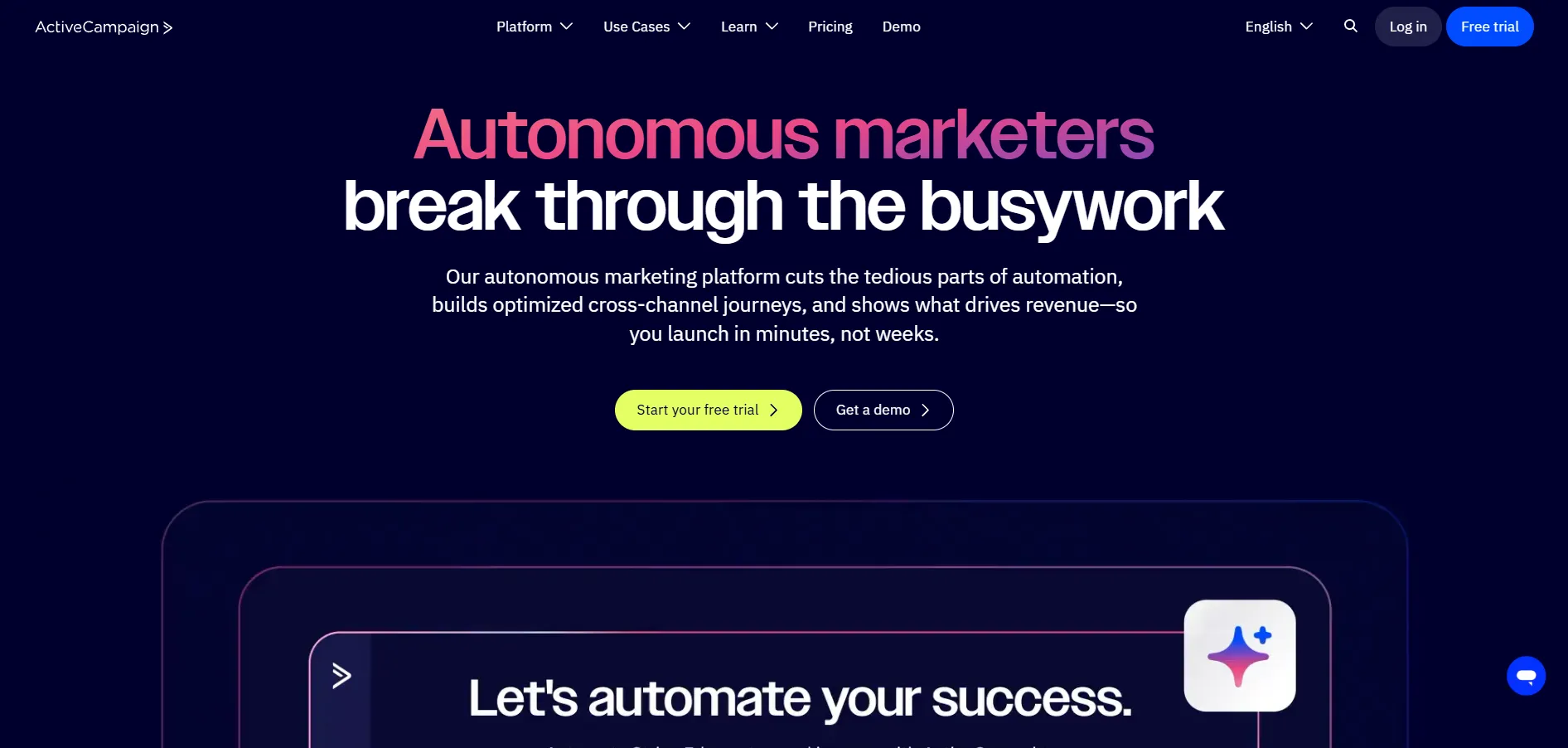
ActiveCampaign delivers marketing automation software at accessible price points for growing B2B companies. The platform combines email marketing, CRM, and automation with intuitive workflow builders designed for teams without technical resources or dedicated marketing operations staff.
ActiveCampaign Key Features:
- Affordable Pricing: Makes sophisticated automation accessible for small business and startups with limited budgets
- Visual Automation Builder: Conditional logic enables non-technical marketers to create complex workflows through drag-and-drop
- Built-in CRM: Provides contact management, deal tracking, and pipeline visibility without requiring separate tools
- Email Deliverability: Strong deliverability rates and detailed engagement tracking help optimize campaign performance
- Predictive Sending: Uses historical data to improve timing and prioritization for lead scoring
Pros and Cons of ActiveCampaign
ActiveCampaign Best Fit: Small to mid-size B2B companies building their first marketing automation strategy. Teams want comprehensive functionality at accessible price points without enterprise complexity.
ActiveCampaign Pricing: Lite from $15/month; Plus from $49/month; Professional from $79/month.
7. Act-On
Act-On provides B2B marketing automation designed for mid-market organizations seeking practical lead management without enterprise complexity. The platform balances functionality with usability for marketing teams managing the complete customer lifecycle from awareness through retention.
Act-On Key Features:
- Adaptive Lead Scoring: Automatically adjusts based on engagement patterns and real-time prospect behavior signals
- Webinar Integrations: Supports B2B event marketing with automated registration, reminders, and follow-up sequences
- Account-Based Analytics: Identifies engagement patterns across entire buying committees for coordinated outreach
- Workflow Builder: Enables quick campaign creation and iteration without requiring coding skills
- Behavioral Tracking: Website visitor intelligence informs lead prioritization and content personalization
Pros and Cons of Act-On
Act-On Best Fit: Mid-market B2B marketers wanting practical automation without enterprise-level complexity or pricing. Teams needing solid lead management and nurturing without dedicated marketing operations resources.
Act-On Pricing: Professional tier from $900/month; Enterprise tier with custom pricing based on contacts and features.
Comparison Table
The table below compares key capabilities across leading B2B marketing automation platforms. Use this overview to identify which tools match your team's requirements.
Core Use Cases Across the Customer Lifecycle
B2B marketing automation delivers measurable value at every stage of the sales process.
- Lead Generation: Capture inbound leads through landing pages, enrich contact data, score based on fit and engagement, and route high-intent prospects to sales teams instantly.
- Lead Nurturing: Build automated email sequences aligned to the buyer's journey, deliver relevant content based on engagement, and deploy multi-channel touchpoints across email, social media, and phone.
- Sales Enablement: Send real-time alerts for prospect engagement, automate meeting scheduling and follow-up, and coordinate account-based marketing efforts across buying committees.
- Customer Retention: Execute onboarding sequences, trigger expansion opportunities based on usage patterns, and manage renewal touchpoints.
How to Choose the Right B2B Marketing Automation Platform
Start with an outcome-first methodology: identify 2-3 prioritized use cases with measurable targets like conversion rates or meeting bookings.
Evaluation Criteria for Enterprise Buyers
Enterprise organizations require stringent security (GDPR/CCPA compliance, SOC 2 Type II), governance (role-based access, audit trails), scalability, bi-directional CRM integration, and deliverability management.
What's the Best Platform for Small Business?
11x delivers autonomous execution, allowing lean teams to compete without additional hires. ActiveCampaign offers practical email marketing with basic automation. HubSpot Starter provides unified CRM and marketing tools.
Implementation Best Practices
Successful B2B marketing automation deployments follow a phased approach. Here is a sample implementation you can follow:
- Phase 1: Foundation (Weeks 1-4): Audit existing processes, configure CRM integration, implement initial lead scoring, and launch first automated campaigns.
- Phase 2: Expansion (Weeks 5-12): Develop segmentation strategy, create multi-touch nurture programs, implement lead routing, and add multi-channel touchpoints.
- Phase 3: Scale (Months 4-6): Deploy AI-powered personalization, implement attribution modeling, and expand to ABM programs targeting key accounts.
Next Steps for Your Marketing Team
B2B marketing automation transforms how GTM teams generate pipeline. The platform landscape spans rule-based tools to autonomous systems. Your choice depends on team resources and growth ambitions.
11x delivers autonomous execution. Alice generates pipeline through outbound across email and LinkedIn. Julian captures inbound demand through instant phone qualification. Together, they create a continuous revenue engine operating 24/7.
Ready to transform your B2B marketing automation strategy? Schedule a demo with 11x.
Frequently Asked Questions
A B2B marketing automation strategy uses technology to execute repetitive marketing tasks, nurture leads, and deliver personalized experiences. It includes lead scoring, segmentation, email campaigns, and CRM integration. 11x's Alice and Julian operate as autonomous digital workers executing complete prospecting and qualification workflows.
Core components include lead scoring, segmentation, email marketing, CRM integration, and analytics. Advanced platforms add multi-channel execution, AI-powered personalization, and predictive capabilities. 11x goes further by combining these components into autonomous agents that execute without manual workflow configuration.
Automation captures prospects through landing pages, enriches profiles with firmographic data, scores based on fit and engagement, and routes qualified leads to sales teams instantly. It ensures consistent follow-up that manual processes cannot match at scale. 11x's Alice actively prospects across email and LinkedIn, identifying high-intent buyers and engaging them with personalized outreach.
Key metrics include conversion rates, cost per lead, lead velocity, marketing-sourced pipeline, and revenue attribution. Track both efficiency metrics (time saved, tasks automated) and effectiveness metrics (conversion improvements, deal acceleration). 11x customers typically see a 50% decrease in cost per lead and 30% increase in meetings booked per AE.
Small businesses benefit from platforms balancing functionality with accessibility. 11x provides enterprise-grade autonomous execution at accessible scale, replacing manual SDR work without requiring large teams. ActiveCampaign offers affordable email automation with basic CRM. HubSpot Starter provides unified marketing and CRM for growing teams. The right choice depends on whether you prioritize manual control or autonomous execution.