Customer Data Cleansing: The GTM Guide
Master customer data cleansing to boost GTM performance. Compare top tools, learn best practices, and see how 11x automates data quality at scale.

Dirty data costs enterprises over $15 million per year. That figure from Gartner accounts for missed meetings, bloated pipelines, and sales cycles that stall before they close. For GTM leaders, the problem compounds daily. Duplicate records clog your CRM. Missing phone numbers derail outreach. Outdated job titles send marketing campaigns to the wrong buyers.
Customer data cleansing is the systematic process of identifying and correcting inaccuracies, removing duplicate records, and filling missing values across your customer datasets. When executed properly, it transforms bad data into high-quality data that powers segmentation, personalization, and revenue forecasting.
This guide breaks down how to clean customer data effectively, which data cleansing tools actually deliver results, and how AI-powered automation eliminates the manual burden that slows your team down.
What Is Customer Data Cleansing?
Customer data cleansing is the process of detecting and correcting errors in your customer records. It includes removing duplicate entries, fixing typos, standardizing format inconsistencies, and validating contact information like phone numbers and email addresses.
The data cleansing process differs from data transformation. Transformation converts data from one format to another. Cleansing removes data that does not belong in your dataset, whether it is incorrect, corrupted, or incomplete.
Your CRM data accumulates dirty data from multiple sources. Manual data entry introduces typos. Data integration from marketing campaigns and third-party data sources creates duplicates. Job changes and company mergers render firmographic data obsolete. Without regular data cleanup, your sales teams waste hours on outreach that bounces or reaches the wrong decision-makers.
Four types of data typically require cleansing in GTM operations.
- Identity data includes names, job titles, and contact information
- Descriptive data covers firmographic attributes like company size and industry
- Behavioral data tracks engagement, purchases, and interactions
- Qualitative data captures preferences, feedback, and sentiment
Each type demands specific validation and standardization rules to maintain data quality across your customer profiles.
Why Data Quality Directly Impacts Your Bottom Line
Sales teams lose trust in CRM data when phone numbers fail, and emails bounce. Marketing teams build segmentation models on outdated customer records. RevOps leaders struggle to forecast accurately when pipeline data is riddled with quality issues.
The consequences extend beyond wasted effort. The Bridge Group's 2025 SDR Metrics Report found that top-performing SDRs generate 22% higher meeting-to-opportunity conversion rates when teams track full-funnel metrics instead of activity volume alone. Clean data enables that precision. Dirty data makes it impossible.
High-quality data creates compounding advantages across your GTM motion.
- Sharper segmentation improves targeting accuracy and conversion rates
- Validated contact data reduces bounce rates and improves deliverability
- Complete customer profiles enable personalization at scale
- Accurate firmographic data supports B2B data enrichment workflows
The Seven Steps of Customer Data Cleansing
A structured data cleaning process ensures consistency across your datasets. These seven steps form a repeatable template for maintaining data hygiene.
1. Data Auditing and Assessment
Start by examining your existing data to understand the scope of quality issues. Identify which fields contain missing values, which records have duplicate entries, and where format inconsistencies exist.
Run reports on field completion rates, bounce rates from recent marketing campaigns, and SDR feedback on contact accuracy. This assessment reveals where to focus your data scrubbing efforts.
2. Deduplication
Duplicate records fragment your view of customer relationships. They inflate metrics, trigger redundant outreach, and confuse sales teams about account ownership.
Deduplication uses matching algorithms to identify records that represent the same entity. Matching criteria typically include email address, company domain, phone numbers, and name variations. Merge rules then determine which field values survive when records combine.
3. Standardization
Inconsistent formatting undermines segmentation and reporting. Standardization applies uniform rules across your datasets.
Common standardization tasks include normalizing phone number formats, converting state names to abbreviations, standardizing job title variations, and applying consistent capitalization. This creates uniformity that enables accurate filtering and analysis.
4. Data Validation
Validation confirms that the data conforms to the defined business rules. Email validation checks format and deliverability. Phone number validation verifies active lines. Address validation confirms physical locations exist.
Strong validation catches data entry errors before they pollute your CRM. It also identifies records that have decayed since initial capture.
5. Filling Missing Data
Missing information limits what you can do with a record. You cannot segment by company size if that field is empty. You cannot route leads by region without location data.
Options for handling missing data include removing incomplete records, inferring values from related fields, or using AI data enrichment to append verified information from external data sources.
6. Data Enrichment
Enrichment goes beyond fixing errors. It adds new data points that increase record utility for GTM execution.
Enrichment typically appends firmographic attributes, technographic signals, direct dials, and verified email addresses. This transforms minimal inputs into actionable customer profiles ready for outreach.
7. Ongoing Monitoring and Governance
Data cleansing is not a one-time project. Customer data decays continuously as people change jobs, companies merge, and contact information expires.
Establish data governance rules that define ownership, refresh cadences, and quality thresholds. Schedule regular data audits to catch decay before it impacts operations.
The Best Data Cleansing Tools for GTM Teams
The table below compares five leading data cleansing platforms across key evaluation criteria: automation depth, AI sophistication, CRM integration quality, and governance controls. Use this overview to identify which tools match your team's requirements before reading detailed breakdowns. The comparison reveals a clear spectrum from batch enrichment providers to autonomous execution platforms that maintain data quality continuously through active workflows.
Comparison of Platform, AI Depth, Integrations, and Automation Capabilities
The data cleansing market spans from basic batch enrichment tools to fully autonomous execution platforms. Understanding how solutions differ across AI sophistication, integration depth, and automation capabilities helps you match technology to your team's GTM motion and data quality requirements.
The table below compares five leading platforms across the dimensions that matter most for sustained data hygiene: how deeply AI drives decision-making, which systems integrate natively, and whether the platform executes autonomously or requires manual activation after enrichment.
Each platform solves data quality challenges differently. The following breakdowns explain what each tool does best, where limitations appear, and which GTM teams gain the most value from adoption.
1. 11x
11x transforms data cleansing from a maintenance task into autonomous execution through digital workers that operate as true virtual team members. Alice handles outbound prospecting while Julian manages inbound qualification, continuously enriching and validating CRM records as they execute core revenue workflows. Unlike static enrichment tools, 11x maintains data quality as a byproduct of live sales execution.
Key Features:
- True autonomy where Alice and Julian own complete prospecting and qualification workflows, enriching data while executing outreach
- Real-time validation and continuous enrichment as buying signals detected across LinkedIn, email, and web activity trigger instant profile updates
- Automated deduplication and standardization during prospecting workflows eliminate manual cleanup cycles
- Deep CRM integration with bi-directional sync to Salesforce and HubSpot that maintains audit trails and compliance logs
- Self-learning algorithms that refine data quality rules based on conversion outcomes and engagement patterns
Here's the condensed version:
Ideal Fit: GTM teams that want to eliminate manual data cleanup while improving CRM accuracy continuously. Organizations seeking autonomous execution that maintains clean, enriched records as a natural byproduct of prospecting and qualification. RevOps leaders tired of scheduling quarterly data audits when automation can sustain quality daily.
ROI Impact: Gupshup saw a 50% increase in SQLs per SDR after adopting Alice, enabled partly by consistently clean and enriched CRM data powering outreach. Teams typically see field completion rates improve by 40-60% within 90 days as 11x enriches records during every interaction.
Here are all sections reformatted to match the 11x template:
2. ZoomInfo
ZoomInfo offers one of the largest verified B2B contact and company datasets for teams prioritizing breadth and accuracy in enrichment coverage. The platform combines human verification with automation to clean CRM data, add firmographic fields, and validate contact details at scale.
Key Features:
- Comprehensive B2B database with over 200 million verified contacts and 100 million company profiles
- Intent data and web activity signals identify high-propensity accounts for prioritization
- Strong integration with major CRMs, including Salesforce, HubSpot, and marketing automation platforms
- Technographic data reveals technology stack and infrastructure details for targeted segmentation
- Bulk enrichment capabilities handle large datasets efficiently for one-time cleanup projects
Ideal Fit: Large B2B organizations focused on accurate enrichment and segmentation for account-based marketing programs.
ROI Impact: Teams leverage ZoomInfo's comprehensive database to improve targeting accuracy and reduce time spent on manual research, particularly valuable for enterprise ABM programs requiring deep account intelligence.
3. Clearbit
Clearbit specializes in real-time enrichment through an API-first design that fills missing attributes instantly when new records enter your system. Speed defines the platform's value proposition, with enrichment happening in milliseconds.
Key Features:
- Real-time API enrichment with 200+ firmographic fields including company size, industry, and location
- Instant attribute filling enables real-time personalization during inbound interactions
- Strong developer documentation and API reliability for technical teams building custom workflows
- Domain-to-company matching identifies accounts from website visitors and form submissions
- Lead scoring and routing automation through Clearbit Reveal improves speed-to-lead
Ideal Fit: Marketing teams optimizing high-velocity inbound flows where form fill accuracy and instant routing drive conversion.
ROI Impact: Clearbit enables marketing teams to personalize inbound experiences instantly, improving conversion rates on high-intent form fills and website visits through immediate lead routing and attribute enrichment.
4. Apollo.io
Apollo.io combines a prospect database with built-in enrichment and light automation features, making it accessible for smaller teams building an initial data infrastructure. AI models cross-verify contact records before syncing to CRM systems.
Key Features:
- Extensive verified database with 275+ million contacts provides affordable access to enrichment data
- Built-in email sequencing and list generation bridge the gap between enrichment and execution
- Chrome extension enables instant enrichment from LinkedIn profiles and Gmail contacts
- Technographic and intent signals included alongside firmographic attributes
- Pricing structure suits small to mid-size sales teams with limited enrichment budgets
Ideal Fit: Small to mid-size sales teams constructing initial enrichment pipelines and prospecting databases on constrained budgets.
ROI Impact: Apollo.io provides cost-effective access to contact data and basic sequencing for growing teams, reducing the need for multiple point solutions while keeping total stack costs manageable.
5. Cognism
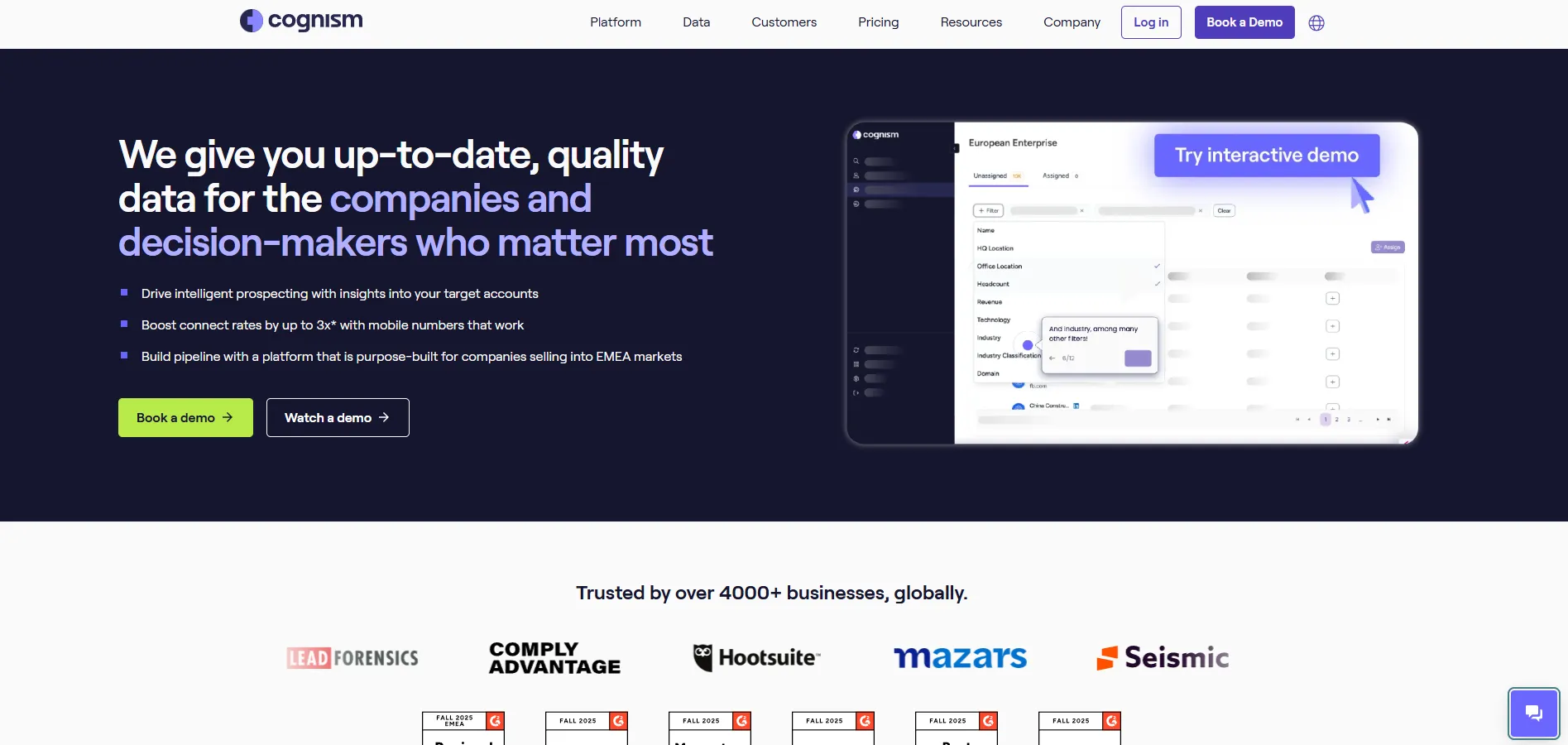
Cognism positions itself as the compliance-first enrichment platform for international teams operating under strict privacy regulations. The dataset is fully GDPR and CCPA aligned with consent-verified contact information across EMEA, North America, and APAC.
Key Features:
- GDPR/CCPA-certified enrichment with transparent data provenance and consent tracking
- Diamond Data system combines AI-driven validation with human verification for industry-leading accuracy
- Strong European coverage with verified contact information across multiple languages and markets
- Compliance reporting and audit trails built into every record for regulatory confidence
- Intent and technographic overlays support targeted segmentation while maintaining privacy standards
Ideal Fit: Revenue teams operating in the European Union or handling sensitive data under strict privacy frameworks.
ROI Impact: Cognism delivers compliance confidence for international teams, particularly valuable for organizations expanding into European markets where GDPR violations carry significant financial and reputational risk.
CRM Data Cleansing Best Practices
Your CRM is the operational hub for sales and marketing execution. Keeping it clean requires discipline and the right data cleaning tools. Apply these five best practices to sustain data quality without overwhelming your team:
Prevent bad data at entry
The cheapest fix is prevention. Stop errors before they enter your system:
- Configure form validation to catch typos and formatting errors in real time
- Require standard formats for phone numbers and email addresses
- Use dropdown fields instead of free text to enforce consistency
Establish clear ownership
Ambiguous ownership leads to neglected data. Create accountability:
- Assign specific fields and record types to individuals or teams
- Define who updates accounts after closed-won deals or customer churn
- Build data quality responsibilities into RevOps workflows
Automate where possible
Manual data cleanup does not scale. Automation reduces burden while improving consistency:
- Automate deduplication to catch duplicate records before they fragment account views
- Apply format standardization rules for phone numbers, addresses, and job titles
- Run enrichment workflows that fill missing fields without manual research
Modern data cleansing tools automate these tasks at scale. 11x takes automation further by maintaining data hygiene as a byproduct of autonomous prospecting and qualification. Alice continuously enriches CRM records by detecting buying signals across LinkedIn, email, and web activity.
Integrate data sources thoughtfully
Every new data source introduces potential quality issues. Before connecting integrations:
- Define how records merge when duplicates appear across systems
- Establish which fields take precedence when conflicting values exist
- Configure deduplication rules to prevent multiple records for the same contact
Measure and report on data quality
What gets measured gets managed. Track these metrics to connect data quality to business outcomes:
- Field completion rates across email, phone, company, and job title
- Duplicate creation rates to monitor governance effectiveness
- Bounce rates and contact decay to measure how quickly records become outdated
- Time savings for SDRs who previously researched missing information manually
When SDR metrics improve after cleanup initiatives, you have proof of impact that justifies continued investment.
Key Metrics to Track Data Cleansing Performance
Quantifying the impact of data cleansing connects maintenance work to business outcomes. Without clear metrics, data quality initiatives feel like cost centers rather than revenue drivers. Establishing the right KPIs demonstrates ROI, justifies continued investment, and helps prioritize which cleansing efforts deliver the greatest impact on pipeline velocity and conversion rates. Track these six indicators to monitor improvement and align data quality directly to GTM performance.
Data Quality Metrics
Track field completion rates across critical fields like email, phone, company, and job title. Monitor duplicate creation rates over time. Measure contact decay by tracking bounce rates and disconnected phone numbers after enrichment.
Operational Impact Metrics
Connect data quality to sales enablement outcomes. Compare bounce rates before and after cleansing initiatives. Track reply rates on outreach campaigns using cleansed versus uncleansed contact lists. Measure time savings for SDRs who previously spent hours researching missing information.
Revenue Attribution
The strongest case ties cleansing to pipeline and revenue. Calculate the value of deals sourced from enriched records. Compare win rates on opportunities with complete versus incomplete customer profiles. Quantify the cost of bad data through lost meetings and stalled deals.
Teams using 11x see these metrics improve automatically. Gupshup generated 50% more SQLs per SDR after deploying Alice, driven partly by consistently clean and enriched CRM data powering outreach.
Stop Losing Pipeline to Dirty Data
Clean CRM data drives higher conversion rates, better targeting, and more accurate forecasting. Manual cleanup delivers temporary fixes; automation sustains quality continuously.
Unlike traditional data cleansing tools that treat hygiene as a separate function, 11x embeds it into autonomous GTM execution. Alice and Julian maintain clean, enriched records while prospecting and qualifying, ensuring your CRM improves with every interaction. Data quality becomes a byproduct of revenue generation, not a drain on RevOps capacity.
Want to turn data cleansing from a cost center to a growth driver? Book a demo with 11x to see how digital workers transform data quality into pipeline velocity.
Frequently Asked Questions
A common example is fixing phone number formats across your CRM. One record might store a number as (555) 123-4567 while another uses 5551234567. Standardization converts both to a uniform format like +1-555-123-4567, enabling automated dialers to process records correctly and improving reporting accuracy.
11x performs standardization automatically during live workflows. When Alice researches prospects, or Julian qualifies inbound calls, they validate and standardize contact information in real time, eliminating format inconsistencies before they reach your CRM.
Follow a systematic seven-step process: audit existing records to identify quality issues, remove duplicates using matching algorithms, standardize formats for phone numbers and addresses, validate contact information against external sources, fill missing values through enrichment, add new data points to increase record utility, and establish ongoing governance to prevent decay.
11x embeds cleansing into continuous GTM execution. Alice and Julian maintain data hygiene while prospecting and qualifying, meaning your CRM improves automatically with every prospect interaction rather than through periodic cleanup projects.
CRM data cleansing corrects, deduplicates, and enriches customer records in your CRM system. It removes errors, standardizes formats, validates contact details, and fills missing fields, ensuring sales and marketing teams work from accurate, complete information. Clean CRM data improves segmentation accuracy, enables personalization at scale, and increases forecasting reliability.
11x transforms CRM cleansing from a maintenance function into a byproduct of autonomous execution. The platform maintains clean, enriched records continuously through Alice's prospecting workflows and Julian's qualification conversations, with all updates syncing directly to Salesforce and HubSpot.
The five best practices are preventing bad data at entry through validation rules, establishing clear ownership of data quality responsibilities, automating cleansing workflows to reduce manual effort, integrating data sources thoughtfully with defined merge rules, and measuring data quality metrics consistently to track improvement. Prevention costs far less than correction, while automation ensures consistency that manual processes cannot match.
11x automates four of these five practices natively: preventing errors through real-time validation, automating deduplication and enrichment workflows, integrating thoughtfully with existing CRM systems, and tracking data quality metrics automatically. This reduces the manual burden on RevOps teams while sustaining higher data quality continuously.
Effective data cleansing requires understanding of data structures and CRM systems, familiarity with data cleaning tools and automation platforms, attention to detail for identifying inconsistencies, analytical skills for pattern recognition, and knowledge of data governance principles. Teams must recognize when records represent duplicates despite formatting differences and establish validation rules that catch errors without blocking legitimate entries.
For teams adopting AI-powered cleansing, the skill requirement shifts from manual execution to strategic oversight. 11x simplifies this transition by handling technical execution autonomously while providing clear visibility into how Alice and Julian maintain data quality across every interaction.